Did you know collagen may contain heavy metals?
Collagen peptide supplements are often marketed with claims about clean ingredients, high absorption, and improved skin elasticity. But there are other things you should really check before choosing a product.
You need to know where the collagen comes from, how much of the key ingredient it actually contains, and what safety testing the product has undergone.
Fish collagen, in particular, is derived from marine sources, which may be highly exposed to heavy metals, microplastics, and other environmental contaminants.
This means that even when you take collagen to improve your skin, it may instead contribute to more skin irritation or breakouts.
This guide takes about three minutes to read. I’ll make it easy to understand which ingredients to look for when choosing a collagen supplement and what safety information you should check.


So if you are choosing collagen for firmer skin, why should you take a closer look at the product label?
News reports frequently highlight the growing interest in collagen, and more products continue to enter the market promising firmer and younger looking skin.
Collagen levels are known to begin declining around age 25, with the decline becoming faster around age 40. As we get older and start noticing a loss of skin elasticity, we naturally begin paying closer attention to collagen supplements, not just expensive skin care products.
The package may say “marine collagen,” “clean ingredients,” or “quality tested.” Those words may sound reassuring, but they do not tell you exactly what was tested, where the testing was done, or what the actual results were.
If a brand cannot clearly explain where its ingredients come from and how they were tested, take it off your collagen shopping list.
Comparing Collagen by Source
First, let’s look at the main types of collagen and the advantages and disadvantages of each.
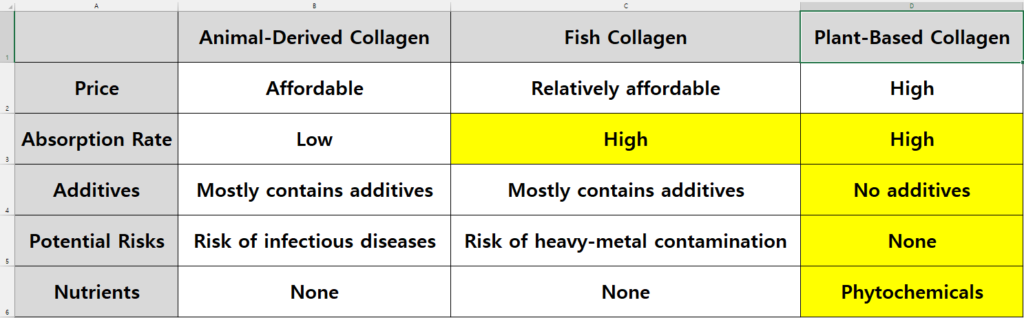
Collagen products can be divided into three broad categories based on their source: animal collagen, fish collagen, and plant-based collagen.
They may all carry the word “collagen” on the package, but that does not mean they are the same.
Let’s take a closer look at what consumers often miss about each source.
1. Animal Collagen

Animal collagen is usually sourced from cows or pigs.
Its main advantage is price. It is generally less expensive than many alternative sources.
The downside is that it may have a larger molecular structure, which can make it less favorable from an absorption standpoint.
There are also concerns about other infections associated with mammalian sources.
Animal collagen is widely used, so do not assume a familiar ingredient is automatically the right one.
2. Fish Collagen


Consumers who do not want bovine or porcine collagen often choose fish collagen instead.
Fish collagen peptides are widely promoted for their smaller molecular size and easier absorption.
It has become a popular alternative to other animal based sources and is now commonly found across the collagen supplement market.
But there is a less attractive side to this popular ingredient.
Fish derived ingredients can have a strong fishy smell and taste. Manufacturers may use sweeteners, flavors, and other additives to cover them.
You may think you are buying collagen, but you could also be getting a long list of ingredients added mainly to make the product easier to swallow.
The bigger issue is the possibility that the fish used to make the collagen were exposed to heavy metals and microplastics.
Some research has reported elevated arsenic levels in tilapia, a fish that may be used as a collagen source.
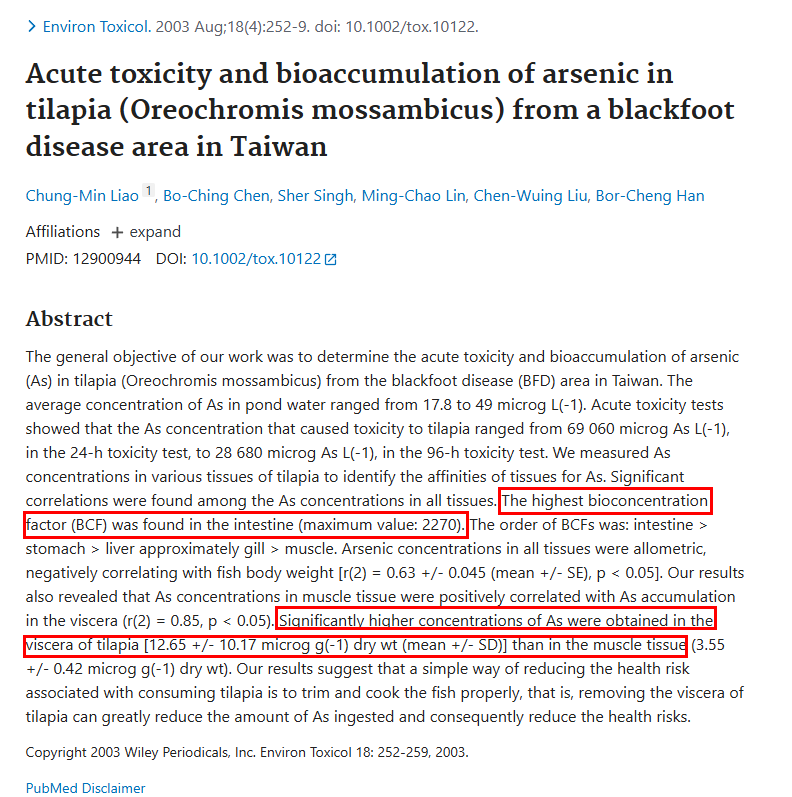
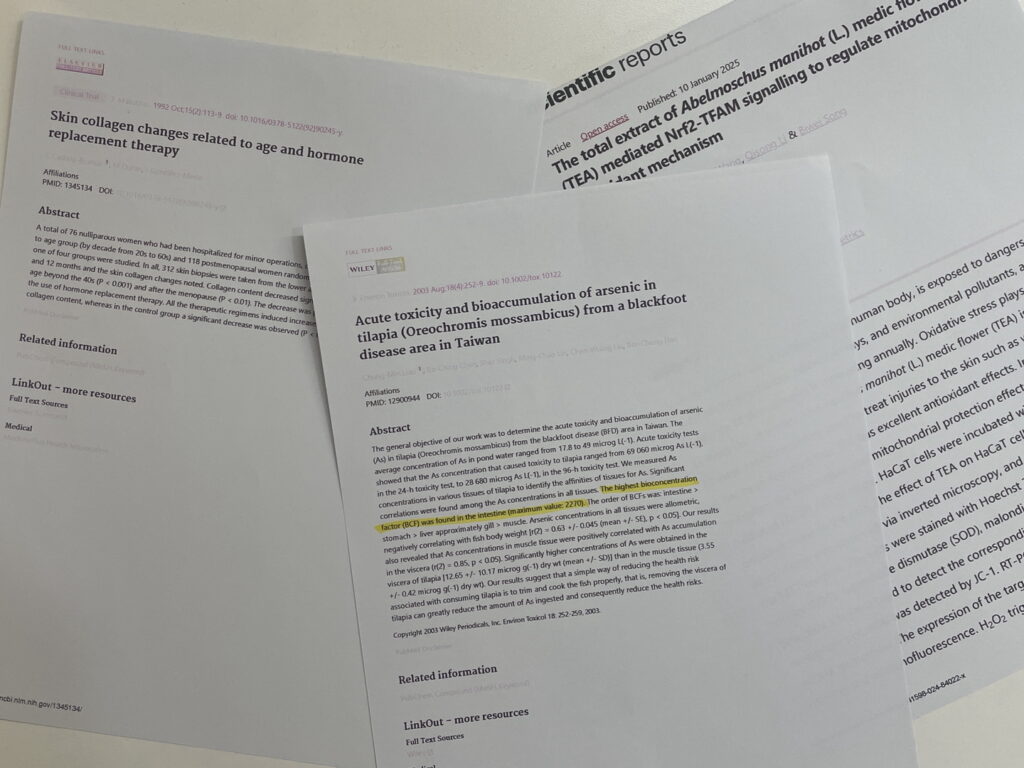
Arsenic can cause vomiting and diarrhea at high exposure levels. Severe exposure may also affect the nervous system.
Consumers may choose fish collagen to avoid concerns associated with other animal-derived sources. However, if they do not consider the possibility of contamination, they may end up right back where they started.
3. Plant Based Collagen

Plant collagen is a newer type of collagen ingredient that has recently emerged, made by extracting collagen from plants such as hibiscus and canola.
In the past, some products advertised as plant collagen were actually made primarily with fish or pork collagen. They added a small amount of plant based excipients and then marketed the products as plant collagen.
In other words, these products were not true plant collagen.
There were also plant collagen products sold overseas under names such as Collagen Booster and Collagen Builder. However, these products did not contain actual collagen. Instead, they were combinations of vitamins designed to promote collagen synthesis.
Around 2019, low fat plant proteins began attracting attention as part of Silicon Valley food trends, and collagen also became possible to extract from plants.
Vegetarians had limited options not only for collagen but also for protein intake, but the arrival of plant collagen made it possible for them to take collagen more conveniently.
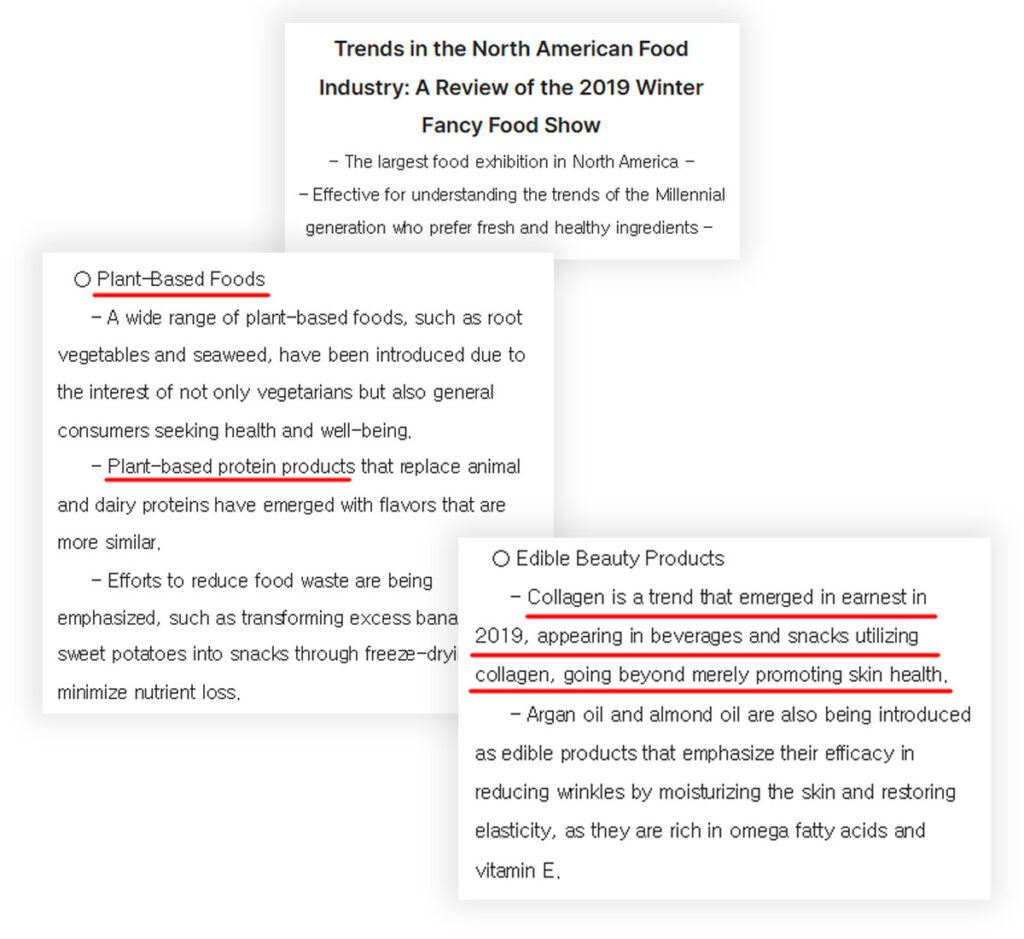
Benefits of Plant Collagen
One of the biggest advantages of plant collagen is that the raw ingredient itself has no noticeable taste, making it easy to take. Because it does not have the fat associated with animal collagen, it also has high water solubility and is easily absorbed.
Plant collagen has gained strong support, starting with vegetarians, and many companies in Korea and other countries are showing significant interest.
There is also less concern with long term use because there is no risk of heavy metals or microplastics. In that sense, an ingredient has been developed that meets two major trends at the same time: vegan and inner beauty.
Korean technology is currently the most advanced in the field of plant collagen.
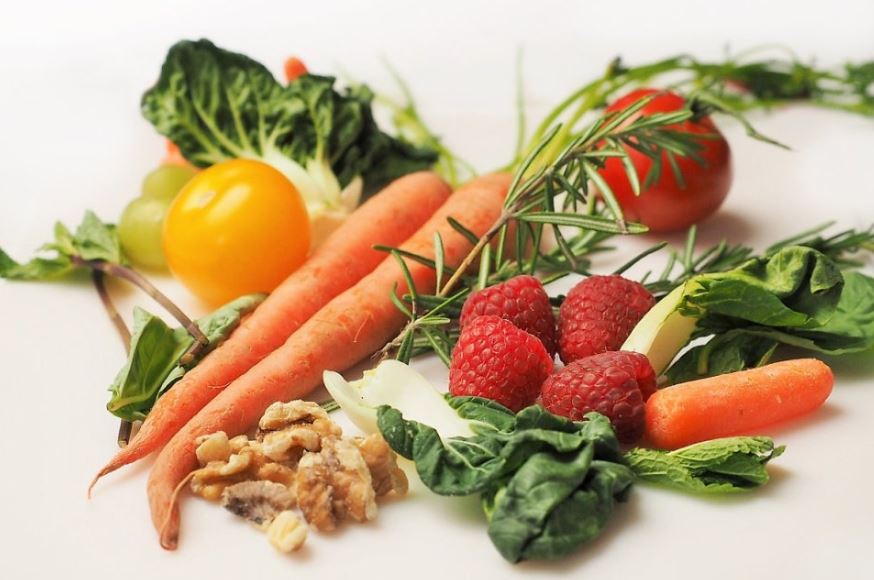
Plant Collagen and Phytochemicals
The unique compounds naturally found in plants are called phytochemicals. These are plant nutrients that can have positive effects on the body.
During the process of extracting collagen from plants, the plant’s natural phytochemicals are also extracted. This means you can consume both collagen and phytochemicals at the same time.
For example, collagen products extracted from hibiscus can also provide phytochemicals such as anthocyanins and delphinidin, which are antioxidant compounds.
Of course, there are also disadvantages. There are still relatively few plant collagen products available on the market, and the raw ingredients tend to be expensive.
Can Collagen Really Come From Plants?
Fish collagen has dominated the collagen industry for years, but that is beginning to change.
As concerns about ocean pollution and microplastics grow, more consumers are looking for cleaner, more sustainable alternatives.
This raises an obvious question: Can collagen really come from plants?
Not exactly. Manufacturers do not extract the same collagen protein found in animals directly from plants. Instead, some use biotechnology to process plant-derived amino acids into forms designed around key collagen-related sequences such as GPH.
GPH refers to glycine, proline, and hydroxyproline, three amino acids associated with collagen.
Because collagen is broken down into smaller peptides and amino acids before absorption, the total milligram count on the label is not the only factor to consider.
The goal of plant-based collagen ingredients is to provide important collagen-related amino acids while avoiding fishy taste and reducing concerns about marine-sourced contaminants.
When choosing a vegan collagen supplement, do not stop at the word “vegan.” Check what the product actually contains and how it was made.
What to Check Before Buying Collagen
Do not choose one based only on price, popularity, or the largest number on the package. Turn the product around and check these five points.
✅ What Source Does It Use?
Fish collagen is popular because of its relatively small molecular size and affordable price. But strict manufacturing standards do not prove that every product is completely free from heavy metals or other marine-related concerns.
For consumers looking for a plant based alternative, plant sources such as canola, hibiscus, and Golden Hibiscus may be worth examining.
In particular, golden hibiscus extract has been studied for its potential relationship with melanin production and factors involved in skin elasticity.
That is why the exact source matters. Look for a product that clearly identifies the plant material it uses, including whether it contains golden hibiscus leaf material.
✅ How Much Actual Collagen Does It Contain?
Do not trust the biggest number printed on the front of the package.
The number of grams on the label may be the total weight of the powder, not the actual amount of the key plant based collagen ingredient.
For example, if a 2,000-milligram packet contains only 60 percent of the primary ingredient, you are getting just 1,200 milligrams. The rest comes from other ingredients.
And do not assume that a higher number automatically means a better product. What matters is how much of the ingredient you actually want is included in each serving.
Check the Supplement Facts panel and full ingredient list.
If the brand hides the exact amount of its key ingredient, the number on the front means very little.
✅ Is It Clean, Tested, and Truly Vegan?
Some collagen powders contain sweeteners, fillers, binders, or artificial flavors to improve taste, texture, or convenience.
Then check whether the company provides actual heavy metal and pesticide residue test certificates.
“Tested for quality” is not enough. It does not tell you what was tested, who performed the test, or what the results showed.
Also look for recognized vegan certification. A product calling itself “plant-based” does not automatically prove that every ingredient and manufacturing process meets vegan standards.
Before buying, confirm three things:
Comparing Products on the Market
Using the same criteria, I compared three vegan collagen products without letting the brand names influence the decision.
I looked at what the primary ingredient actually was, how much of it each serving provided, what else was added, and whether the company provided meaningful information about testing and vegan status.
The front of the package did not get a vote. The ingredient list did.
The three comparison criteria were:
1.Source of the primary ingredient
2. Actual amount of the primary ingredient per serving
3. Unnecessary additives, safety testing, and vegan certification
The table below explains the major differences among the products.
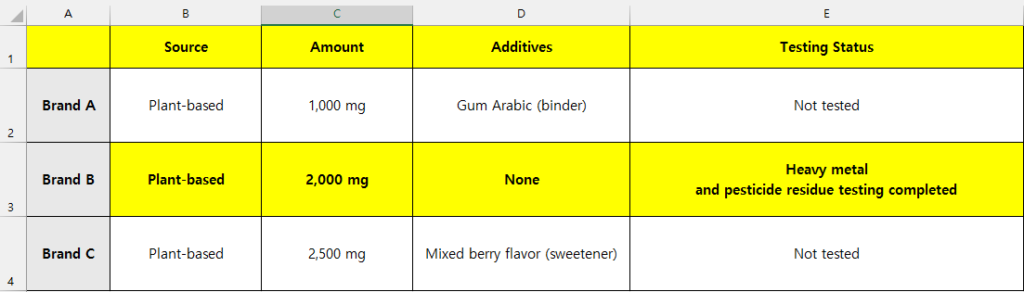
Note: This review is intended to teach consumers how to read product labels, not to directly advertise a specific brand. Brand and product names are not disclosed.
Most of the products I reviewed contained sweeteners, flavors, binders, or additional ingredients.
That is not automatically a problem. Gummies, tablets, and liquid products often need extra ingredients for taste, texture, or form.
But if your priority is getting a simple formula with a clearly stated primary ingredient amount, those extras matter.
Based on the criteria above, Brand B came closest to what I was looking for.
Why ‘Brand B’ Stood Out
The first thing I noticed was the formula.
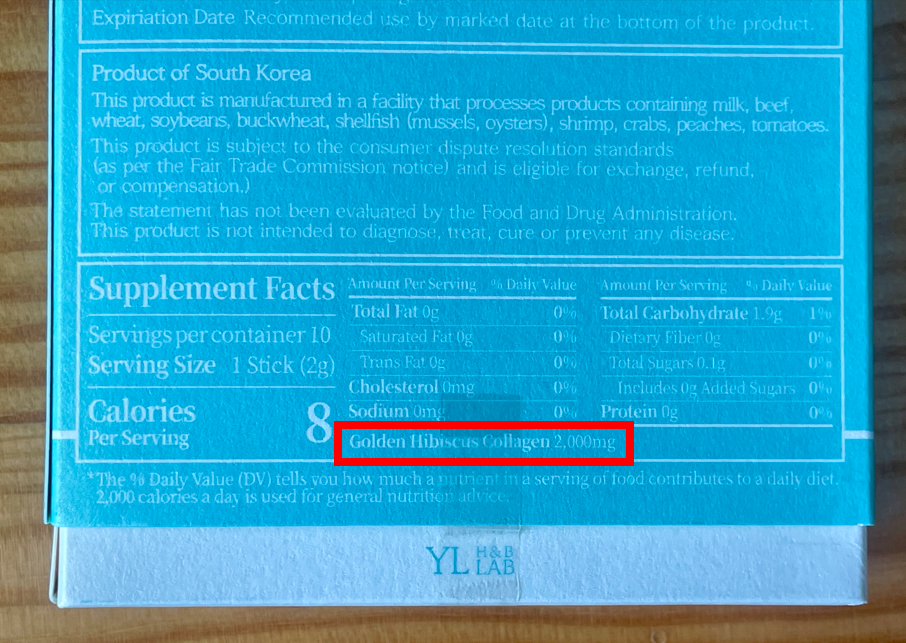
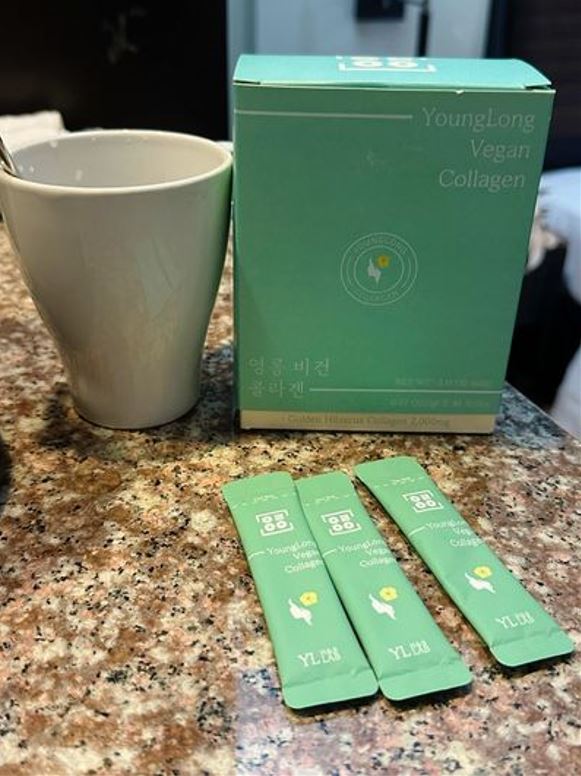
Brand B currently lists 100% Golden Hibiscus extract from Korea as its only ingredient, with 2,000 milligrams per daily stick. The product page also states that it contains no added sweeteners, fillers, or artificial flavoring.
Many conventional collagen boosters use multi ingredient formulas that can include artificial flavors, fillers, sugars, and other additives.
That is an important distinction when you are comparing it with a typical collagen booster.
Many products sold as vegan collagen boosters use combinations of amino acids, vitamin C, minerals, and botanical ingredients intended to support your body’s own collagen production.
Brand B takes a different formula approach. Instead of a long vitamin and mineral blend, the product centers on one ingredient: Golden Hibiscus extract.
That makes the label much easier to evaluate. You know what the primary ingredient is, and you know how much you are getting.
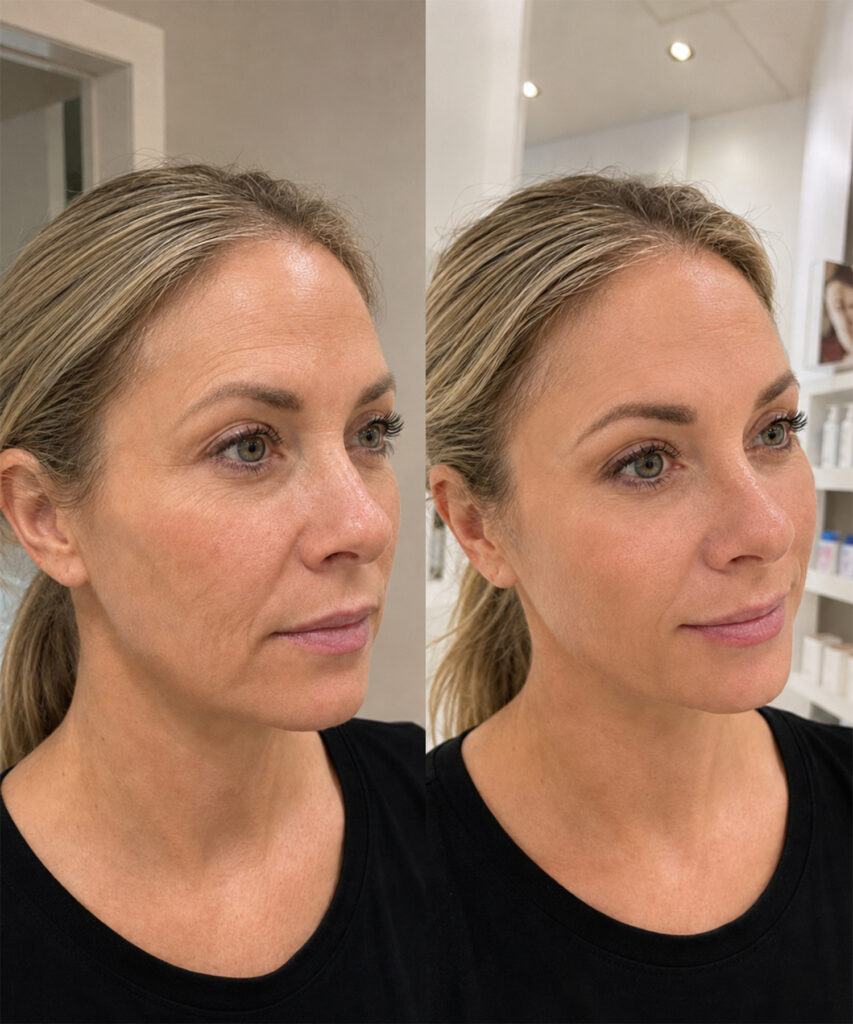
That makes the label much easier to evaluate. You know what the primary ingredient is, and you know how much you are getting.
The Safety Claims Need Documentation
This is where I would pay the most attention.
Brand B states that its Vegan Collagen has completed heavy metal and pesticide residue testing, and the current product page describes the product as tested free of heavy metals and pesticides.
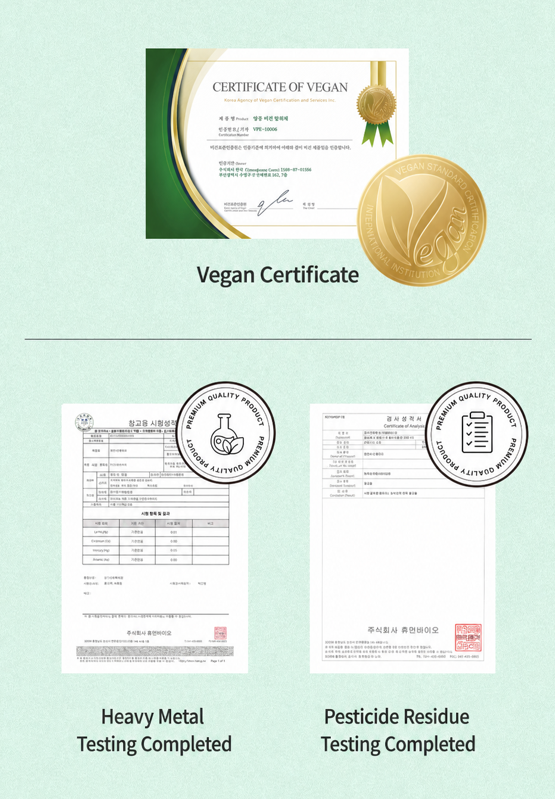
That documentation matters because the whole point of this guide is transparency. If I tell you to check testing before buying collagen, the product I recommend should be willing to show the same information.
The same standard applies to vegan claims. The Brand B product page identifies Vegan Collagen as Certified Vegan and states that the formula contains no animal derived ingredients.
What Are U.S. Buyers Saying?
The ingredient list looked promising, but I also wanted to see what real customers had to say after actually using it.
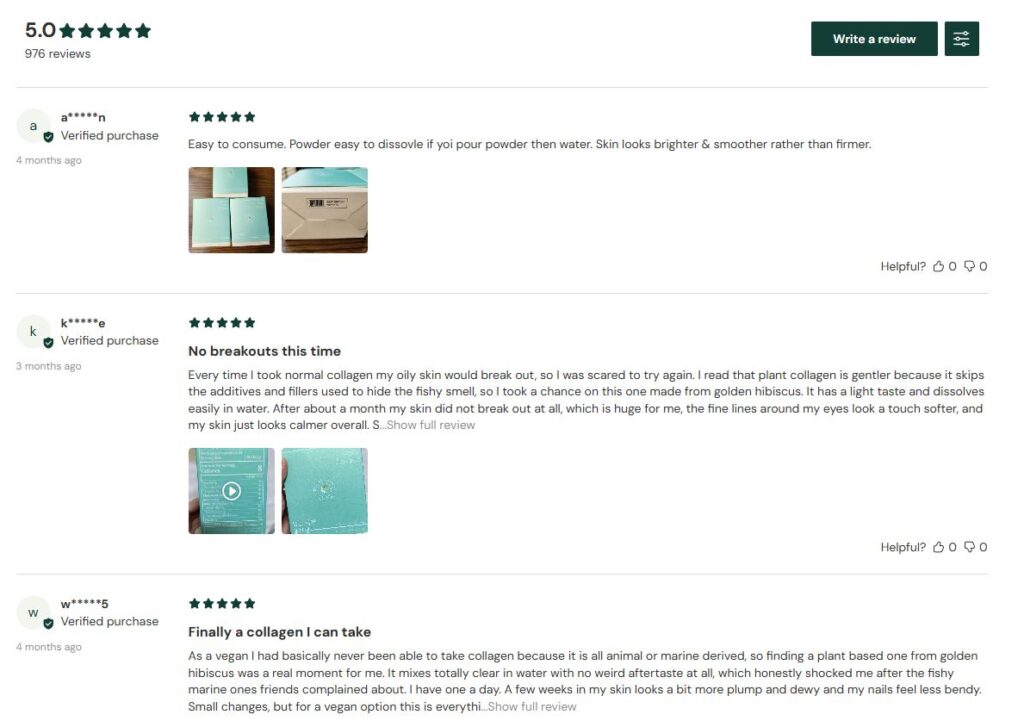
Brand B Vegan Collagen currently has a 5 out of 5 rating from 976 customer reviews. Many U.S. buyers describe positive experiences with consistent use, including visible changes in how firm and smooth their skin looks and improvements in the appearance of fine lines.
The cost is also easier to put into perspective when you look at it by the day. With one stick per day, it comes to about $1.20 a day.
For a daily serving that provides 2,000 mg of Golden Hibiscus plant collagen, along with a simple ingredient list and documented safety testing, that daily cost makes it a practical option for consumers who want to make collagen part of their regular routine.
See exactly what’s inside and how it’s tested before you decide.
Check the Supplement Facts panel on the back.
Final Label Check: Everything you need to know before buying vegan collagen, reduced to four lines.
1. If the ingredient source is vague, put it back.
2. Ignore the biggest number on the front. Check the actual amount of the primary ingredient per serving.
3. Skip products loaded with sweeteners, binders, and artificial flavors. Choose one that discloses heavy metal and pesticide residue test results and carries clear vegan certification.
heavy metal and pesticide residue testing.
The front of the package sells the promise.
The back label reveals what you are actually buying.
Scientific References
Skin collagen changes related to age and hormone replacement therapy →
Acute toxicity and bioaccumulation of arsenic in tilapia (Oreochromis mossambicus) from a blackfoot disease area in Taiwan →