You thought it was a probiotic bacterium — turns out it’s a yeast. From why it survives antibiotics to what the IBS research really shows, in plain words.
Hi, I’m the Mom Pharmacist.
If you have a sensitive stomach or live with IBS, you’ve probably heard the name Saccharomyces boulardii at least once.
The name may sound familiar, but it’s hard to know exactly what it does or what it’s actually good for.
So today, based on published research, I’ll walk you through this yeast that keeps working right alongside antibiotics — in plain words.
1. What Saccharomyces boulardii is
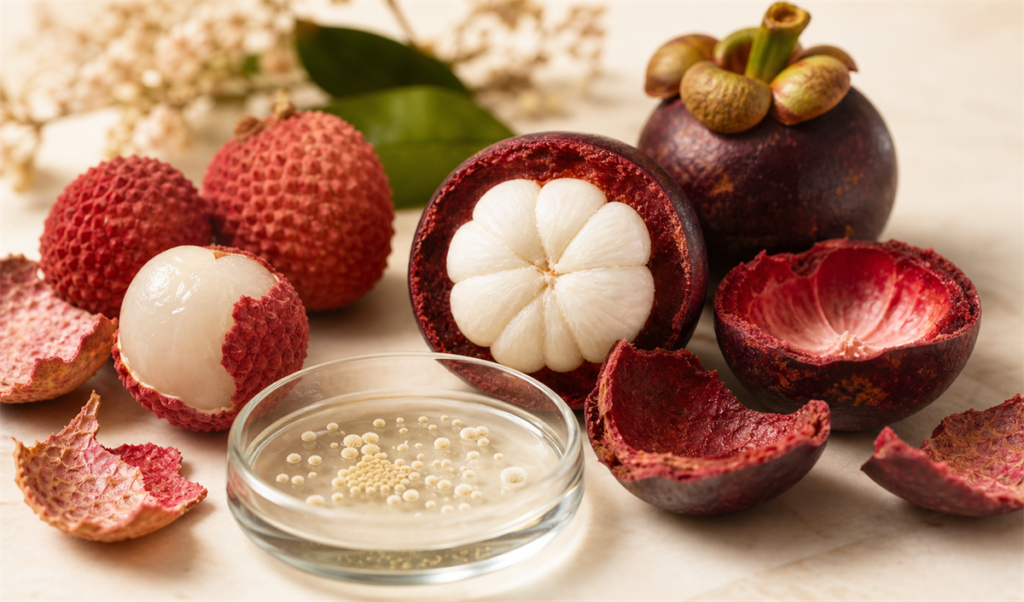
Saccharomyces boulardii is a beneficial probiotic yeast first isolated from the peels of tropical fruit. Today it’s widely used to help keep digestion in balance.
Unlike bacterial probiotics, it’s a living microbe that stays active as it passes through you but doesn’t settle down in your gut.
Unlike bacteria such as Lactobacillus, its outer wall is made of tough fibers (beta-glucans and chitin). That sturdy wall gives it a natural resistance, so it survives even when you take it alongside oral antibiotics.
Its cells are large and thick-walled, so they aren’t broken down by stomach acid or bile and reach the gut alive.
And it doesn’t stick around — once you stop taking it, it clears out within 3–5 days. That’s not a flaw; it’s by design, so the microbe never takes up permanent residence.
2. What it does in the gut

It doesn’t settle in, but as it passes through it does several helpful jobs at once.
1️⃣ It strengthens the gut wall.
It tightens the small gaps between the cells lining your gut, reducing the “leaking” that happens during antibiotics or digestive stress.
2️⃣ It acts as a decoy for toxins.
Harmful microbes like cholera make toxins; this yeast grabs them before they can stick to your gut and carries them out of the body.
3️⃣ It supports your immune system.
It raises the antibodies that guard the gut surface and calms the signals that trigger inflammation.
4️⃣ It aids digestion.
It boosts the enzymes that break down sugars, helping digestion keep going even while you’re on antibiotics.
These barrier-protecting and anti-inflammatory actions are summarized in a review paper[1].
💊 Pharmacist Mom Talk
Because S. boulardii keeps working alongside antibiotics, people sometimes take it together with bacterial probiotics like Lactobacillus.
Bacterial probiotics get weakened when taken with antibiotics, so they’re usually spaced at least two hours apart from the antibiotic dose.
But this yeast is tough against antibiotics, so you can take them together!
3. What the clinical evidence shows
1️⃣ Antibiotic-associated diarrhea (adults and children)
Antibiotics kill good and bad microbes alike, which can cause diarrhea. Because it resists antibiotics, S. boulardii can help reduce this diarrhea.
Meta-analyses pooling many controlled trials report that taking this yeast during or right after a course of antibiotics lowers the risk of antibiotic-associated diarrhea in both adults and children[2][3].
In children specifically, kids who took it had fewer days of loose stools during antibiotic treatment[4].
2️⃣ Irritable bowel syndrome (IBS)
IBS is common — it affects more than 1 in 10 people worldwide. It brings recurring belly pain, diarrhea or constipation (or both, taking turns), and bloating.
Research shows that people with IBS tend to have a weaker gut wall — less of ZO-1, a key protein that binds the lining cells tightly together — and a gut immune system that overreacts[5].
This irritated, leaky barrier is thought to amplify the pain and the hypersensitivity.
This is where S. boulardii comes in. In cell and animal studies, the yeast acts on both of those problems — it tightens the barrier to reduce the “leaking” and calms the gut’s inflammatory signals. In one animal model of IBS, it even reduced gut dysfunction[1][6].
4. Dosage and timing
Adults are generally advised about 500–1,000 mg a day (roughly 10–20 billion CFU); children about 250 mg a day. (CFU is just a count of the live helpers.)
Check the daily amount by use in the table below.
| Use | Daily amount | When to take it | How long |
|---|---|---|---|
| Antibiotic-associated diarrhea (adults) | 500–1,000 mg | Same time as antibiotics | During antibiotics + 3 days to 2 weeks after |
| Antibiotic-associated diarrhea (children) | 250–500 mg | With antibiotics | During antibiotics + a few days after |
| General gut support | 500 mg | Any time of day | Varies; reassess after 2–3 months |
5. Comparing products
Search around and you’ll find a flood of these supplements. Before buying, check just two things — which strain it uses and how much (CFU).
Those two alone change how well it works. Make sure the strain name and CFU are clearly on the label, and that it comes from a maker with real quality control.
Here are the products I looked at.
| Brand | Key features |
|---|---|
| Jarrow S. boulardii + MOS | Adds MOS sugars to better block bad microbes; capsule; no fridge needed; contains a prebiotic |
| YoungLong Yeast Biotics Sensitive | Low-FODMAP certified; probiotics only, no prebiotics; 5-strain blend including S. boulardii; with Vitamin D and white peony; no fridge needed; uses the studied DDS-1 and UABla-12 strains; capsule or powder |
| Florastor | Uses the CNCM I-745 clinical strain; no fridge needed (capsule or stick) |
💊 Pharmacist Mom Talk
One tip when choosing a probiotic with S. boulardii: if your gut runs on the sensitive side, look for a product without prebiotics.
Prebiotics are food for probiotics, but in a sensitive gut they can ferment and bring on gas or bloating. Picking a prebiotic-free product can take some of that load off your gut.
6. Side effects and who should be careful
When you first start a probiotic yeast or bacteria, you may notice a little gas, mild bloating, or a change in your stool in the first week or two.
It usually settles on its own, and you rarely have to stop.
Talk to your doctor first if you
- have a weak immune system (e.g., HIV/AIDS, an organ or bone-marrow transplant, ongoing chemo)
- are in intensive care (the ICU)
- have a serious bowel disease with a damaged gut lining
- are allergic to yeast or Saccharomyces
- are pregnant or having a severe IBD flare
And if you get a fever, chills, a new rash, dizziness, a rapid heartbeat, or worse abdominal pain or diarrhea after taking it, stop and see a doctor right away.
For anyone with a weak immune system, it’s especially important to rule out fungemia (a yeast infection in the blood).
So, is it actually worth taking?
That’s the tour of Saccharomyces boulardii. In a word: it’s not a bacterium but a probiotic yeast, and it’s fine to take alongside antibiotics.
Its best-proven benefit is lowering the risk of antibiotic-associated diarrhea, in both adults and children.[2][3][4]
For IBS, the early research is genuinely promising: the biology lines up, and small trials already report better quality of life and calmer gut inflammation.
Larger studies are still confirming how much it eases day-to-day symptoms — but the direction is encouraging.
When new research comes out, we’ll take another look. This has been the Mom Pharmacist!
References
- Terciolo C, Dapoigny M, André F. Beneficial effects of Saccharomyces boulardii CNCM I-745 on clinical disorders associated with intestinal barrier disruption. Clin Exp Gastroenterol. 2019;12:67–82.
https://doi.org/10.2147/CEG.S181590 - McFarland LV. Systematic review and meta-analysis of Saccharomyces boulardii in adult patients. World J Gastroenterol. 2010;16(18):2202–2222.
https://doi.org/10.3748/wjg.v16.i18.2202 - Szajewska H, Kołodziej M. Systematic review with meta-analysis: Saccharomyces boulardii in the prevention of antibiotic-associated diarrhoea. Aliment Pharmacol Ther. 2015;42(7):793–801.
https://doi.org/10.1111/apt.13344 - Guo Q, Goldenberg JZ, Humphrey C, El Dib R, Johnston BC. Probiotics for the prevention of pediatric antibiotic-associated diarrhea. Cochrane Database Syst Rev. 2019;4:CD004827.
https://doi.org/10.1002/14651858.CD004827 - Piche T, Barbara G, Aubert P, et al. Impaired intestinal barrier integrity in the colon of patients with irritable bowel syndrome: involvement of soluble mediators. Gut. 2009;58(2):196–201.
https://doi.org/10.1136/gut.2007.140806 - Brun P, Scarpa M, Marchiori C, et al. Saccharomyces boulardii CNCM I-745 supplementation reduces gastrointestinal dysfunction in an animal model of IBS. PLoS One. 2017;12(7):e0181863.
https://doi.org/10.1371/journal.pone.0181863 - Choi CH, Jo SY, Park HJ, Chang SK, Byeon JS, Myung SJ. A randomized, double-blind, placebo-controlled multicenter trial of Saccharomyces boulardii in irritable bowel syndrome: effect on quality of life. J Clin Gastroenterol. 2011;45(8):679–683.
https://doi.org/10.1097/MCG.0b013e318204593e - Abbas Z, Yakoob J, Jafri W, et al. Cytokine and clinical response to Saccharomyces boulardii therapy in diarrhea-dominant irritable bowel syndrome: a randomized trial. Eur J Gastroenterol Hepatol. 2014;26(6):630–639.
https://doi.org/10.1097/MEG.0000000000000094