Hi, it’s Pharmacist Mom.
I bet many of you have had your stomach start gurgling after a glass of milk, followed right away by a nagging ache.
It’s also common to get stomach pain or diarrhea after eating dairy like ice cream, whipped cream, or sweetened condensed milk.
These symptoms come from a problem that happens when you can’t properly digest the lactose in milk and dairy products, what we commonly call “lactose intolerance.”
Lactose intolerance isn’t life-threatening, but small, repeated bouts of discomfort can get in the way of daily life and lower your quality of life at the same time.
Lactose isn’t found only in dairy products.
It can also be hiding in foods like the cream in coffee-shop drinks, bread, salad dressings, and sauces.
Avoiding it completely, or sticking only to lactose-free products, isn’t realistic either.
“So, with lactose intolerance, is cutting out dairy the answer?”
No, there’s no need for that.
As long as you understand lactose intolerance properly, you can still eat and enjoy plenty of dairy, and even bread, cake, and coffee-shop drinks.
But this is exactly where many people get stuck, unable to find a way.
The answer is surprisingly simple.
You just need to help lactose get broken down properly.
1. What Is Lactose Intolerance?
Lactose intolerance is a condition where there’s not enough lactase, the enzyme in the small intestine that breaks down lactose, so the body has a hard time digesting and absorbing lactose.
Lactose is a sugar found in mammals’ milk.
It’s in breast milk, as well as animal-based dairy products like milk, yogurt, cream, and cheese.
How Is Lactose Digested in the Body?
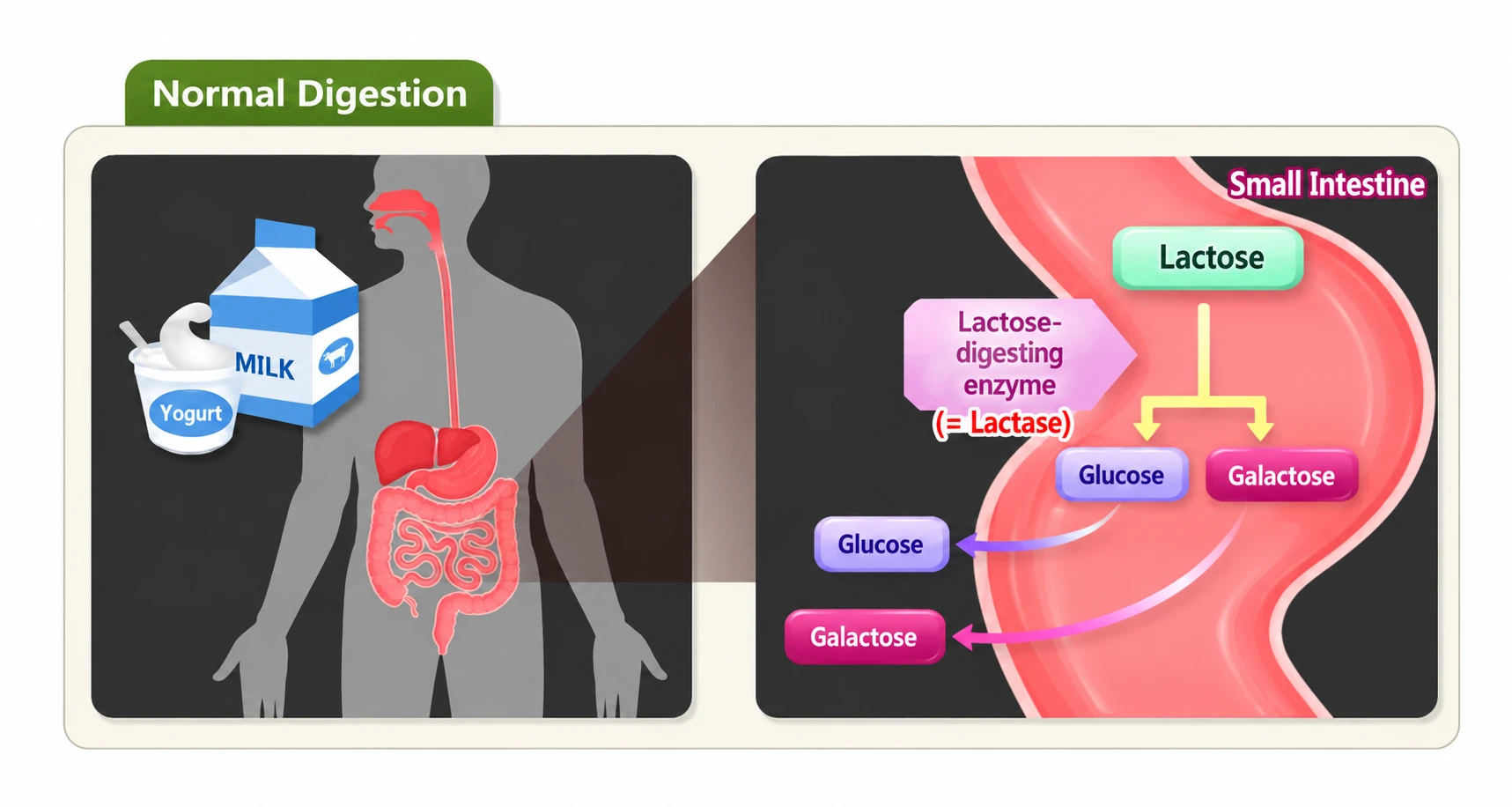
In normal metabolism, lactose is broken down in the small intestine by the action of lactase into glucose and galactose, which are then absorbed into the body.
In other words, your body needs to make enough lactase.
But in most people worldwide, this lactase enzyme naturally declines after infancy.
That’s because once breastfeeding ends and lactose intake drops, the body needs less lactase.
As a result, lactose intolerance often shows up in adulthood.

If you have lactose intolerance, you don’t have enough lactase, the enzyme that digests lactose, so the lactose you eat isn’t broken down in the small intestine and passes straight into the large intestine.
Once it reaches the large intestine, the lactose is fermented by gut bacteria, producing a mix of hydrogen, carbon dioxide, and methane gas.
On top of that, the undigested lactose sharply raises osmotic pressure in the gut and draws in water, which leads to symptoms like diarrhea, bloating, and abdominal pain.
That’s how lactose intolerance symptoms develop.
2. How to Manage Lactose Intolerance

Most dairy products, including milk, can’t help but contain lactose.
Products like milk, sweetened condensed milk, and ice cream, where the lactose stays intact during processing, are high in lactose.
On the other hand, fermented products like cheese and yogurt tend to be relatively low in lactose.
That’s why some people get symptoms from milk but can eat yogurt without any problem.
Others, though, react even to the tiny amounts of lactose in snacks or bread.
Is There a Treatment for Lactose Intolerance?
There’s a lot of talk about whether lactose intolerance can be treated, including anecdotal cases, but to get straight to the point, lactose intolerance is not a condition with a definitive cure.
But it’s entirely possible to overcome it.
The simplest and most reliable way is to avoid foods that contain lactose.
Once you stop eating them, the symptoms naturally go away.
But that’s easier said than done.
Besides milk itself, dairy is used in all kinds of sauces, desserts, and dishes, so lactose can be hiding in them.
Alternative drinks like almond milk or coconut milk also have their limits as a full replacement for dairy.
And realistically, living your whole life completely avoiding dairy is harder than you’d think.
Option 1: Lactose-Free Products

That’s where lactose-free products come in.
Lactose-free, just as the name says, refers to dairy products in which the lactose has been broken down or removed in advance.
The most common method is adding the lactase enzyme to milk to break lactose down into the simple sugars glucose and galactose.
This way, no lactose itself is left, so even people with lactose intolerance can drink it relatively comfortably.
The advantage is that it has almost the same nutrients as regular milk while reducing symptoms caused by lactose, like bloating and diarrhea.
Lately, a variety of lactose-free products have been launched, not just milk but also yogurt and protein shakes, but not every dairy product has a lactose-free alternative yet.
Option 2: Lactase Enzyme Supplements

So a more convenient and practical approach is to supplement lactase, the enzyme that breaks down lactose itself, from an outside source.
In other words, if you take a lactase supplement before a meal, it temporarily makes up for the lactase you’re missing, so you can break down the lactose you eat more effectively.
When lactose is properly broken down and absorbed in the small intestine like this, less lactose passes into the large intestine, which can prevent the symptoms of lactose intolerance.
This method is especially useful when you want to eat the foods you love in everyday life, and in situations where it’s hard to check the lactose content ahead of time, like eating out or ordering coffee-shop drinks.
If you take a lactase enzyme supplement ahead of time, you can enjoy dairy relatively freely without symptoms like bloating, gas, diarrhea, or abdominal pain caused by undigested lactose.
That’s a big change in terms of quality of life, too.
Taking lactase directly broadens the range of foods you can eat and lets you enjoy dairy without worry, making it the simplest and most practical way.
3. A Pharmacist-Recommended Lactase Enzyme Supplement for Lactose Intolerance
The one I recommend is an enzyme supplement that contains lactase, for the following reasons.
YoungLong FodLac™ Enzyme [FODMAP Enzyme]
1. Lactase Plus FODMAP Enzymes ★
An enzyme supplement that contains lactase, the enzyme that breaks down lactose
2. Lactose-Breakdown Ability Proven in Lab Testing ★
A product whose effect has been proven through a lactose breakdown test

This is the lactose breakdown test data shown on the product’s detail page.
In the control group without lactase, the lactose in the test solution stayed as it was, but in the test group with lactase added, lactose dropped by nearly half in just 10 minutes, and the effect held even after 30 minutes.
At the same time, glucose, which is naturally produced as lactose is broken down, was also confirmed to increase, which is direct evidence that lactase actually broke down lactose effectively.
Such a large drop in lactose in such a short time means it can also help prevent symptoms like borborygmi (stomach gurgling), bloating, diarrhea, and abdominal pain that can occur after eating foods containing lactose.
This test shows how quickly and effectively lactase breaks down lactose, and it supports that it can be of real help to people with lactose intolerance.
3. A Blend of Multiple Enzymes
Beyond the enzyme that breaks down lactose, it’s an enzyme formula that combines a variety of digestive enzymes, including amylase (a carbohydrate-digesting enzyme) and protease (a protein-digesting enzyme), so along with breaking down lactose, it can also help improve overall digestive function.
As an enzyme supplement that contains lactase, it’s one I’d like to recommend to anyone who struggles with symptoms like stomach pain, diarrhea, or bloating when eating dairy.
Lactase is an enzyme naturally found in our bodies, so it’s generally a safe ingredient to use.
It’s also a supplement that helps with lactose intolerance.
If you’ve had to avoid dairy because of lactose intolerance, I hope a lactase enzyme supplement helps you enjoy your meals more comfortably and freely, in both body and mind.
References
*This content has not been evaluated by the U.S. Food and Drug Administration (FDA). This product is not intended to diagnose, treat, cure, or prevent any disease.