
Lately the markets for medicines, dietary supplements, and health foods have been overflowing with unverified information and distorted facts.
As a professional, I believe I have a responsibility to sort out the information consumers actually need and deliver what is certain and accurate, so that they can make the right choices.

From inflammation to vascular health, eye health, and brain health, omega-3 has established itself as an essential supplement for modern life.
It would hardly be an exaggeration to say we live in an age where taking omega-3 has become a must.
That many people look after their health with omega-3, and yet the fact that omega-3 is a nutrient that is especially vulnerable to rancidity often goes unknown.
Rancid oil is, put simply, spoiled oil.
It is much like eating food fried in oxidized oil.
Taking rancid omega-3 isn’t medicine — it’s poison.

And rancidity isn’t the only worry.
Add the anxiety that heavy metals may be accumulating on top of it, and consumers can’t help being concerned.
In the middle of that anxiety, the thing that naturally catches the eye is “plant-based omega-3.” No rancidity to worry about, no heavy metals to worry about — of course it sounds tempting.
So is plant-based omega-3 better than fish-based omega-3?
I often see people choose an omega-3 with no real criteria at all, going only on marketing copy that says it’s safe.
With hundreds of omega-3 products out there, you’ve probably felt lost about which one to pick.
To solve that problem, today I’ve put together an <Omega-3 Buying Guide>.
Rather than simply listing popular products, I’ll compare the labels of products on the market and walk you through why a given omega-3 product is good and what criteria you should use to choose one.
If you’ve been picking your omega-3 because “it was cheap” or “they said it was safe,” I hope today’s post helps you make a wiser choice.
Contents
1. The truth about omega-3
2. How to choose an omega-3
3. Comparing omega-3 products on the market
1. Fact-Checking “The Truth About Omega-3”
Before we get into how to choose an omega-3, I want to address the two questions I’ve been asked most often about it.
Not advertising or promotional material put out by sellers — I’ll fact-check these one by one as a pharmacist, on scientific grounds.
Q&A (1) Is plant-based omega-3 better than fish-based omega-3?
This is one of the questions that always comes up with omega-3.
Omega-3 can be divided into plant-based and animal-based (fish) depending on the source it’s extracted from.
Thanks to advertising along the lines of “plant-based omega-3 carries less risk of concentrated heavy metals than fish-based omega-3, so even pregnant women can take it with confidence, and it actually works better,” the number of people who prefer plant-based omega-3 seems to have grown sharply.
On top of that, here is the marketing logic that plant-based omega-3 sellers emphasize.

Of the omega-3 present in our bodies, DHA accounts for a far larger share, and because this DHA converts into EPA, taking plant-based omega-3 is said to be enough.
Add to that a lower risk of heavy metals, radiation, microplastics, and endocrine disruptors, and from a consumer’s point of view it can’t help sounding tempting.
Because it’s called plant-based, it somehow feels safer, and because DHA is said to convert into EPA on its own, it feels like you don’t need to bother with fish-based omega-3.
But is that really so?
And if it does convert, how much actually converts?

According to research, when DHA is taken through food the conversion rate from DHA to EPA is less than 1.4%, and when DHA was taken as a supplement at a high dose over a long period, there are findings of conversion up to a maximum of 12%.
In other words, however much DHA is metabolized into EPA, it converts only in the small range of 1.4% up to a maximum of about 12%.
Apply that to an actual intake: if we take 500mg of DHA, the EPA produced is a mere 7mg, and at most around 60mg.
Barely a speck, isn’t it?

What’s more, the very explanation plant-based omega-3 companies put forward — that “DHA converts into EPA in the body” — has been shown through research not to be true.
It is correct that EPA levels in the body rise even when you take DHA alone, but the reason those EPA levels rise is not that DHA converts into EPA; it is the result of DHA becoming abundant in the body, which slows the rate at which EPA is metabolized (used up).
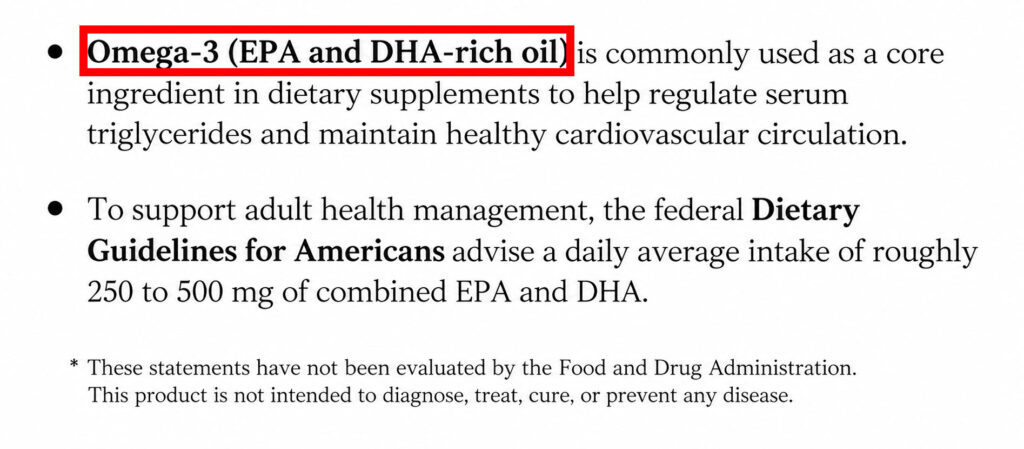
What we generally call omega-3 refers to “oils and fats containing EPA and DHA.”
Taking both in balance is what matters.
At present, dsm-firmenich’s plant-based omega-3 is the only one with a relatively high EPA content, but that ratio is on the order of DHA:EPA = 5:2, still low on EPA and therefore rather short on balance.
Fish-based omega-3 already contains DHA and EPA in balance, so is there really any reason to go out of your way for a plant-based omega-3 like this?
Q&A (2) Fish-based omega-3 — are heavy metals really okay?

When fish-based omega-3 comes up, the issue that always flares up is heavy metals.
The word that always appears when the heavy-metal risk of omega-3 is raised is the food chain.
The higher up the food chain something sits, the greater the accumulation of heavy metals can be.
The bigger the fish that prey on forage fish such as small anchovies, the more heavy metals like mercury and cadmium inevitably build up in their bodies over time.
So it is of course true that fish-based omega-3 has a higher probability of containing heavy metals than plant-based omega-3.

But in my view, worrying about heavy metals in omega-3 is a story from the ’80s and ’90s.
GOED, the global omega-3 industry organization, holds its member companies to strict heavy metal limits.
That means if a company is a GOED member, oil that goes over those limits can’t even make it into their products.
On top of that, the technology at today’s omega-3 raw material suppliers, plant-based or fish-based, has come a long way, so heavy metals barely show up at all.
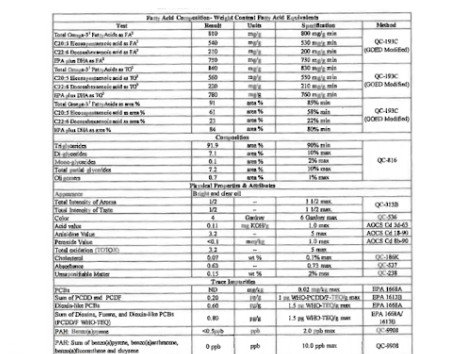
Look at the suppliers’ own raw material test certificates and the heavy metals are all listed there, present at levels hundreds to thousands of times below the limit, so they’re almost never an issue.
People really dislike anything containing even a trace of something known to be bad for the body.
Pregnant women in particular often avoid supplements where words like heavy metals, microplastics, or synthetic additives come up.
And honestly, that’s only natural.
Amid these concerns, the ingredient drawing attention lately is “spirulina.”

Spirulina is a microalga grown in pristine environments, rich in protein and in all sorts of antioxidant compounds.
What stands out most among these is its ability to adsorb heavy metals harmful to the human body — lead, mercury, cadmium and others — and carry them out of the body.
Spirulina is rich in a blue pigment protein called “phycocyanin,” and you could say that the benefits that come up when you search for spirulina are all thanks to “phycocyanin.”
Phycocyanin is unusual in that it binds with cadmium, mercury, lead, aluminum and the like to remove heavy metals, and it is known to help with removing toxic substances such as pesticides and hydrocarbons as well.

Phycocyanin has a distinctive structure that lets it bind with cations, so it envelops heavy metals such as silver (Ag+), offsetting their harmful action and blocking their absorption into the body.
The above is experimental data verifying the binding strength between heavy metals and phycocyanin.
When phycocyanin is tagged with a fluorescent marker and then reacted with heavy metals, the fluorescence disappears, which shows that the two substances did in fact bind.
Thanks to these properties, products have recently been released that keep the advantages of fish-based omega-3 while additionally containing spirulina, which brings heavy-metal adsorption and antioxidant function, making it possible to ease concerns about the safety of fish-based omega-3.
2. How to Choose an Omega-3 Properly
How to choose 1) A highly trustworthy “raw material supplier”

Omega-3 is a supplement where the raw material supplier matters more than with any other.
That’s because which raw material was used and what form it takes make a difference as wide as heaven and earth to absorption, purity, bioavailability, and ease of taking it (the fishy taste).
Because omega-3 is sensitive to rancidity and heavy metals, it’s no exaggeration to say that the “raw material” that forms the product’s foundation determines its quality.
So when choosing a product, the first thing to check is whether it uses raw material from a highly trustworthy supplier whose production and management systems have been verified.

Well-known suppliers include Polaris (France), KD Pharma (Germany), Alaska Omega (USA), and GC Rieber (Norway) — companies with strong reputations in the omega-3 raw material market.
Suppliers like these hold their own proprietary extraction methods built on long tradition and research, and they are widely recognized for purity and safety as well.
All are GOED member companies, and their raw materials are IFOS certified.

IFOS and GOED are international bodies that evaluate and verify omega-3 quality; they test raw material for endocrine disruptors, degree of rancidity, and heavy metal levels, and their threshold values are strictly managed.
Through this certification you can confirm that a product meets safety standards for heavy metals, rancidity, impurities and so on, and it serves as one indicator of trust when choosing a high-quality omega-3.
How to choose 2) The “form” of omega-3
Absorption in the body differs from product to product, and that difference begins precisely with the form of the omega-3.
Depending on the refining method, the molecular structure is classified as TG, EE, or rTG type.
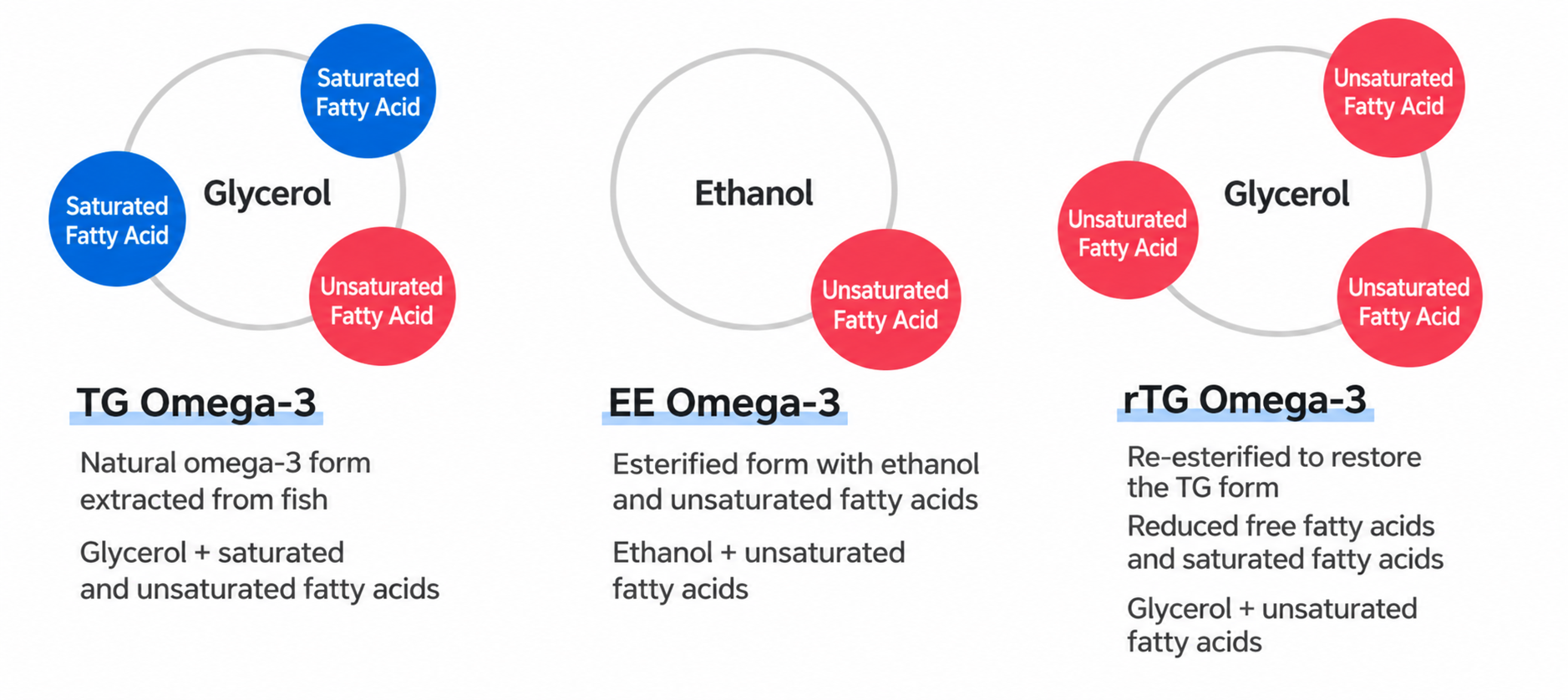
The TG type, the natural state of fish oil as it is, has three fatty acids attached to a glycerol backbone, and of these only one is omega-3 (an unsaturated fatty acid).
The structure is stable and absorption is good, but with unsaturated fatty acids making up only a third, purity is low.
The form that goes through a chemical process to raise purity is the second-generation EE type; it raised the content above the TG type but has the drawback of relatively poorer absorption.
Most omega-3 products coming out these days are third-generation rTG type.
This is a structure similar to the natural TG type, with three unsaturated fatty acids bound to a single glycerol, so both purity and absorption are high, and bioavailability is excellent too.

So when you buy an omega-3, some products state “rTG” right in the product name,
but for products labeled simply “omega-3,” you can check whether it’s rTG or EE type on the Supplement Facts panel or the ingredient list.
How to choose 3) Not the capsule’s weight, but the “amount” and “purity” of EPA and DHA
Look at omega-3 products and you’ll see “X mg per capsule” on the label.
That refers to the weight of the whole capsule.
What matters in omega-3 content is the sum of EPA and DHA, the active components that deliver the various benefits.
So when choosing a product, what matters is checking the sum of EPA and DHA rather than the weight of the capsule.
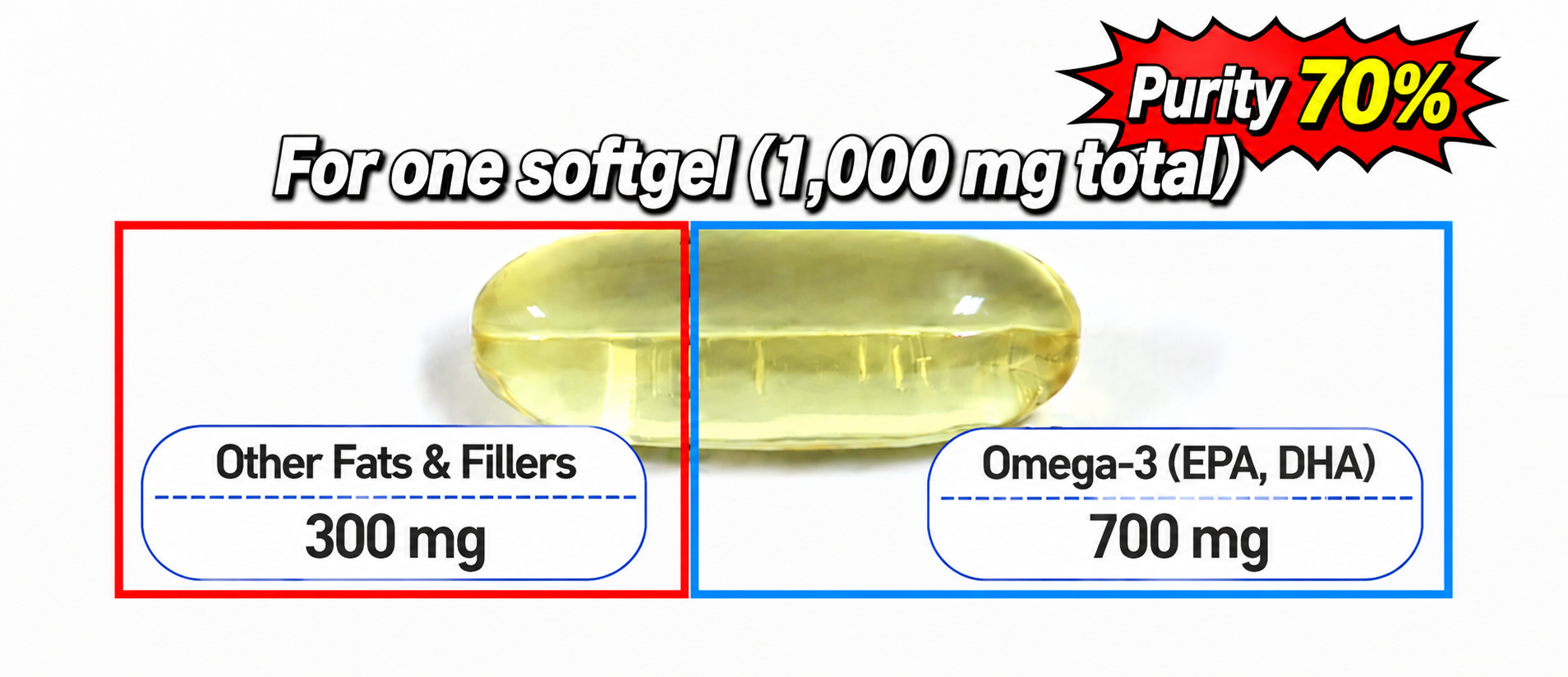
In practice, when you look at the sum of EPA and DHA shown on the Supplement Facts panel, it often differs from the capsule’s total content.
That difference comes from saturated fat and other components, and you can think of it this way: the closer the sum of EPA and DHA is to the total content, the less unnecessary fat there is and the higher the product’s purity.
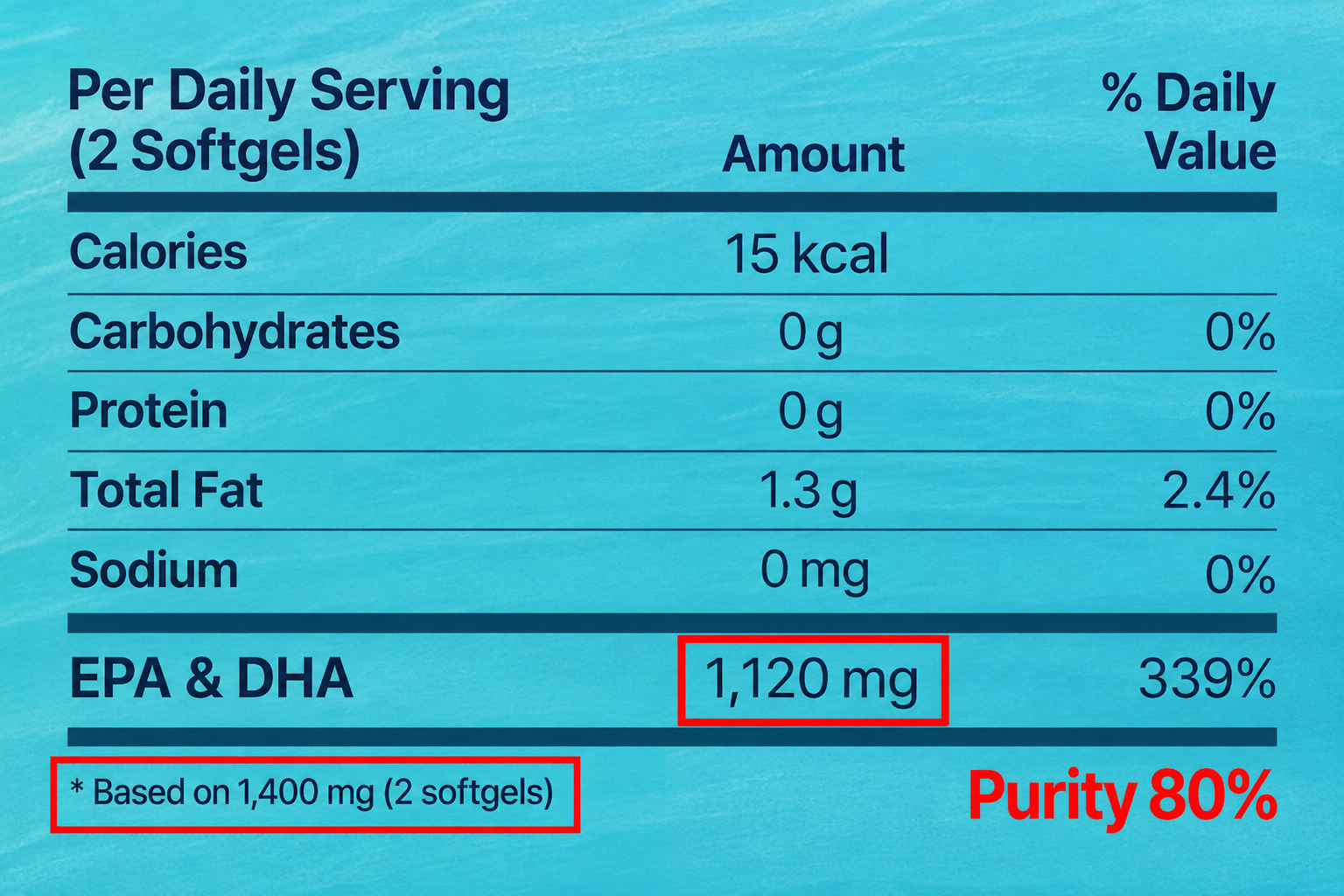
For example, if a 1,400mg capsule contains 1,120mg of EPA+DHA, the purity is 80%.
A difference of about 200mg comes from saturated fat and other components, and the closer the sum of EPA and DHA is to the total content, the fewer impurities there are and the higher the purity of the product.
In other words, the higher the purity, the more of omega-3’s active components you can take in from the same amount of capsule.
So it’s important to check purity this way and choose a product that is at least 80%.

Purity isn’t the only thing that matters. The amount does too.
That’s because the level of health support you can expect from omega-3 changes with how much it contains.
For general adult health, the usual target lands at roughly 250 to 500 mg of combined EPA and DHA per day. Yet according to the latest Dietary Guidelines for Americans, the average American gets only about 110 mg a day.
But even 500 mg is just a floor for basic upkeep, not the level that brings the fuller range of benefits in the chart above. For that you need more.
An omega-3 supplement with a combined 900 mg of EPA and DHA per serving goes well past that floor, covering the full range of benefits omega-3 is taken for — heart, brain, and eye health* — all at once.
And it stays comfortably inside the safety margin. The FDA has concluded that combined EPA and DHA is generally recognized as safe at intakes up to 3,000 mg a day, so 900 mg sits at under a third of that ceiling.
So a product with less than 500 mg of EPA and DHA may be cheap, but it covers basic upkeep at best — it doesn’t reach the starting line in the chart.
To sum up, when choosing an omega-3, check two things rather than the capsule’s size:
① How much the combined EPA and DHA comes to
② What percentage of the capsule’s total weight that amount represents (purity)
How to choose 4) Individual packaging

It’s an easy thing to overlook, but the packaging method also has a large effect on the freshness of omega-3.
The large bottled omega-3 products widely available on the market come into repeated contact with air every time you open the lid.
This becomes a cause of faster rancidity.
Conversely, products in individually sealed PTP packaging have each omega-3 capsule sealed on its own, making them resistant to outside stressors such as temperature, air, humidity, and light, so they keep rancidity to a minimum and preserve the freshness of the raw material for longer.
Of course, a bottled omega-3 product can maintain quality above a certain level too if it has excellent raw material and manufacturing processes, but it’s worth keeping in mind that the packaging method itself is structurally unfavorable for maintaining freshness.
3. Analyzing <Omega-3> Products on the Market

There are so many similar products made from similar raw materials on the market that people often end up lost about which one to take.
And I know all too well that checking and comparing all of this carefully isn’t easy from an ordinary person’s point of view.
So I looked carefully myself for a product that keeps the strengths of existing omega-3 while making up for the weaknesses, and one stood out, so I used that product as an example to analyze what a proper omega-3 product actually is.

I’d say it may well be the cleanest omega-3 product on the market, one that has brought heavy metals all the way down to zero.
If you’re looking for an omega-3 you can take consistently with peace of mind, this is the product I recommend.
There are plenty of products on the market containing vitamin E to prevent oxidation and rancidity, but as a product that makes up for the strengths and weaknesses of existing omega-3 for the safe, complete effect I described earlier, this is personally the combination I recommend most.
It uses raw material that lowers the risk of rancidity through a low-temperature supercritical extraction method on a highly absorbable rTG-type omega-3, and adds vitamin E to guard once more against oxidation and rancidity of the omega-3, plus spirulina for heavy-metal adsorption and antioxidant function — so one dose a day covers all of it together.
The reason plant-based omega-3 drew attention in the first place was that it carries less risk of heavy metal accumulation than fish-based omega-3, letting pregnant women take it with peace of mind.
This product not only helps with adsorbing and eliminating heavy metals but also blends in spirulina, which keeps rancidity and oxidation to a minimum — designed so that pregnant women, and anyone else, can take it with peace of mind.
Beyond that, it uses raw material from the highly trustworthy Polaris, and as a product that has received IFOS certification from raw material through to finished product, it’s a high-quality omega-3 that amply meets safety standards.

On top of that, out of a total of 1,400mg across 2 capsules, the EPA+DHA content is 1,120mg, making it a high-purity product at over 80% active ingredient ratio.
It came across as a product blended with careful attention to every detail, from the omega-3 raw material to the manufacturing method to each secondary ingredient.
It keeps the strengths of both fish-based and plant-based omega-3 as they are, while firmly making up for the heavy-metal concerns that were the weak point of existing products — a product that has put its finger squarely on the limits of what came before.
* This product is available online.
For more detail, search Aqua Glow Omega 3 and take a look for yourself to decide whether it’s the right product for you.
In the omega-3 market, at least, there is no such thing as a bargain product.
If a product’s price is low, it can only be because it’s low quality and hasn’t been properly managed.
A good omega-3 is, in the end, oil that hasn’t gone rancid.
As a pharmacist, it’s disappointing to see how often people buy omega-3s based on celebrity or influencer endorsements without checking the content and quality, or grab the cheapest bottle from an unverified seller on an online marketplace.
Personally, I recommend choosing a verified omega-3 over a bargain one.
Check carefully whether a product meets the criteria I’ve described, and you’ll be able to find the one that suits you.
Thank you for reading all the way through today.
* Effects may vary depending on the individual’s illness or condition.
* This post reflects the personal opinion of Pharmacist Mom.
Reference
[3] Seafood Nutrition Partnership (2018). Seafood Recommendations from the Dietary Guidelines.
[5] Arterburn, L. M., Hall, E. B., & Oken, H. (2006). Distribution, interconversion, and dose response of n-3 fatty acids in humans. The American Journal of Clinical Nutrition, 83(6 Suppl), 1467S–1476S.
[6] GOED Voluntary Monograph – Global Organization for EPA and DHA Omega-3s
*This content has not been evaluated by the U.S. Food and Drug Administration (FDA). This product is not intended to diagnose, treat, cure, or prevent any disease.