Cal-Mag-D: Which Supplement Should You Choose?
Lately, more and more of the patients who visit my pharmacy have been asking for Cal-Mag-D supplements.
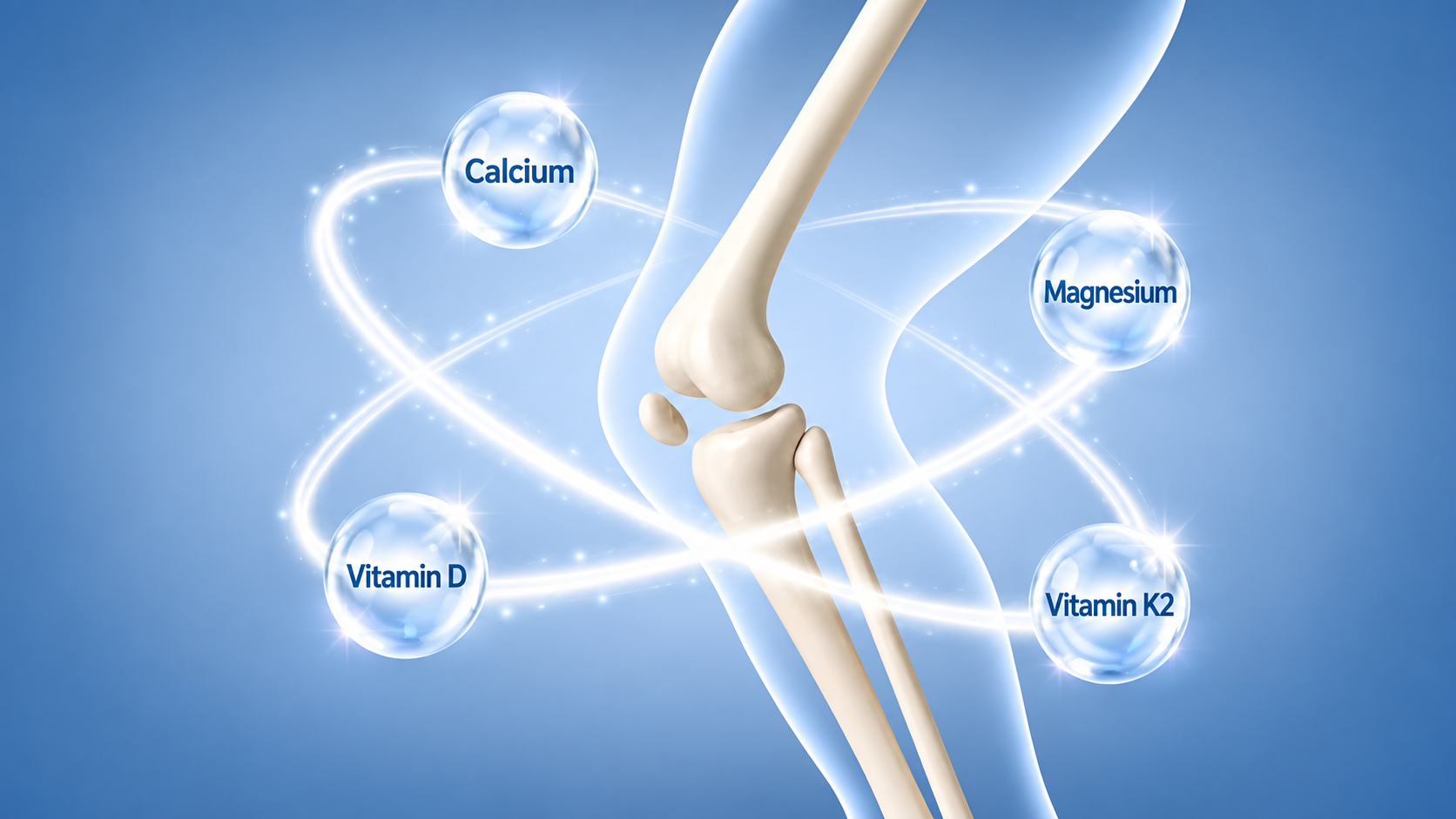
In the past, the common formula was “bone health = calcium,” but these days, more people are taking three nutrients that support bone health, Calcium, Magnesium, and vitamin D, together as a combo known as “Cal-Mag-D.”
That’s because it’s important to keep these key bone-health nutrients in balance so they can do their jobs properly in the body.
However, as it became known that simply supplementing with Cal-Mag-D can actually increase the risk of cardiovascular disease, Cal-Mag-D plus an extra “Vitamin __” has become established as the next generation of calcium supplements.
With safety and absorption in mind, how should you choose a Cal-Mag-D supplement?
✓ Table of Contents
1. Cal-Mag-D: Why Balance Matters
2. How to Take Cal-Mag-D Effectively and Safely
3. How to Choose a Cal-Mag-D Supplement Wisely (Tip ★)
4. Cal-Mag-D Supplements on the Market: Comparison & Picks
1. Cal-Mag-D (Calcium + Magnesium + Vitamin D): Why Balance Matters
The Building Block of Bone: ① Calcium

Calcium, the main mineral that makes up bone, is found mostly in the bones (98%) and teeth (1%).
Absorbed calcium raises bone density, playing a role in making bones even stronger.
After you take calcium, it’s absorbed in the small intestine and then stays in the blood at a steady level, and this blood calcium level is an important physiological factor in maintaining a normal skeleton.
For example, when blood calcium is high, the extra calcium moves into the bones, increasing bone density, and when blood calcium drops, calcium is pulled from the bones into the blood, lowering bone density.
That’s why taking calcium consistently to keep your blood calcium level steady is essential for bone health.
The problem is that calcium itself isn’t absorbed very well.
So you need to supplement enough extra calcium to maintain bone health and prevent critical risks like osteoporosis.
Keep in mind, though, that calcium should be taken only in the amount you need, because taking more than that can cause problems; it’s what’s called a “threshold nutrient.”
In particular, taking too much calcium can lead to calcification in the body and deposits in the blood vessels, so it’s important to take a moderate amount.1
Calcium’s Synergy Partner: ② Magnesium

Calcium and magnesium interact with each other to regulate important physiological functions in the body.
These two minerals are core components of bone, and they also influence the activity of the cells that build bone.
If you take calcium without magnesium, the risk of osteoporosis and kidney stones increases, and on the other hand, if you’re low on magnesium, your blood calcium level can drop, which can cause hypocalcemia.
This can ultimately lead to weaker bones.
Magnesium also plays an important role in regulating calcium metabolism by preventing too much calcium from entering cells and maintaining proper levels.
So when you’re low on magnesium, calcium can build up excessively inside cells and interfere with how they function.
Because magnesium gets used up as your body absorbs calcium, taking too much calcium alone can leave you short on magnesium.
Helping Calcium Absorption: ③ Vitamin D
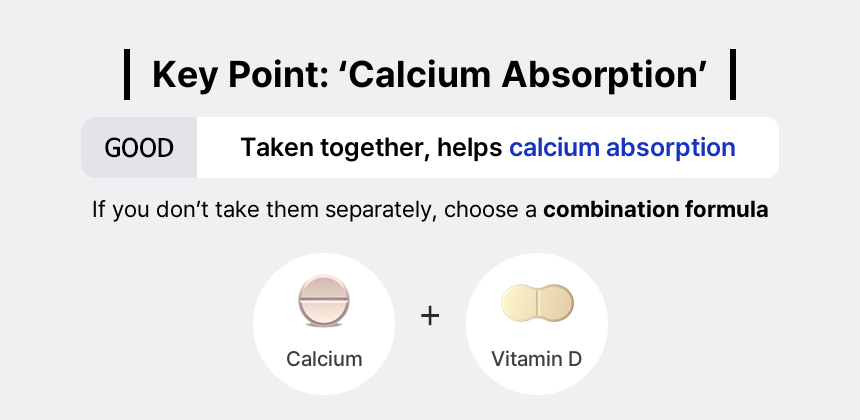
Minerals like calcium and magnesium, which play an important role in bone health, have one drawback: they aren’t absorbed well by the body.
Nutrients with low absorption are best taken together with nutrients that can boost their absorption.
Vitamin D is a key nutrient known for helping calcium absorption: it helps calcium get absorbed in the small intestine, and it moves calcium from the small intestine into the blood.
On top of that, it also keeps calcium levels in the body within the normal range, so no matter how much calcium you take, you won’t get the full benefit if you’re low on vitamin D.

Magnesium is also essential for activating vitamin D, so taking them together creates a synergy that lets them play many roles in the body.
In the past, it was common to take calcium alone for bone health and osteoporosis prevention, but for the past few years, “Cal-Mag-D,” which combines calcium, magnesium, and vitamin D in one, has become the trend.
But just adding magnesium and vitamin D to boost calcium absorption and get a synergy effect doesn’t mean all the calcium you take will move into your bones and do its job.
Of course, it’s true that magnesium and vitamin D are essential for calcium absorption and bone health, but when calcium that isn’t absorbed into the bones lingers in the blood in excess, it can build up on the inner walls of blood vessels and cause calcification.
2. How to Take Cal-Mag-D Effectively and Safely
For Safer Cal-Mag-D: ④ Vitamin K2

That’s why the key is moving calcium into the bones so it doesn’t linger in the blood, and the way to do that is to take Cal-Mag-D together with “vitamin K2,” which helps relocate calcium from the blood into the bones.
Vitamin K2, a nutrient that has recently been gaining attention as a supplement ingredient, could be called the key to bone health.

Here’s how vitamin K2 works in more detail.
1) Vitamin K2 activates a protein called “osteocalcin,” which helps calcium move from the blood into the bones so it can be stored in bone tissue.
2) It also boosts production of MGP protein, which increases the flexibility of blood vessels and prevents calcium from building up in them.
Through this process, taking vitamin K2 means calcium moves into the bones and calcification is suppressed.

Internationally, there has been active research on the risks of calcium supplementation, especially the calcium paradox, and along with it, the importance of vitamin K2, which helps calcium get properly into the bones, has been getting attention.
Until recently, vitamin K2 didn’t get much recognition as a supplement ingredient, but it has been surging in popularity lately.
So now it’s important to properly understand vitamin K2, an essential nutrient to add for bone health, and take it the right way.
3. How to Choose Bone Health Supplements: Cal-Mag-D Buying Tips
In the past, there weren’t many Cal-Mag-D products that contained vitamin K2, but as it has recently gained recognition as a supplement ingredient, a variety of brands have been launching them.
With so many more options now, I’m sure many of you have struggled to pick a product, or are wondering whether the Cal-Mag-D you’re taking might actually fall short, and which product you should choose going forward.
Like other supplements, Cal-Mag-D products vary widely in quality depending on their ingredients, raw materials, ratios, and amounts, so it’s important to compare carefully before choosing.
For those of you in that situation, here’s how to pick a good Cal-Mag-D product.

Tip 1: Calcium and Magnesium, the Ideal Ratio Is 2:1
Calcium and magnesium exist in the body’s tissues in a 2:1 ratio.
Because the two complement each other, if either one is too high or too low, the balance breaks down and problems can arise in the body.
So it’s wise to check the Supplement Facts label and choose a product designed with a 2:1 ratio of calcium to magnesium.
(e.g., calcium 300 mg : magnesium 150 mg)
Calcium and magnesium are essential nutrients, but you can get a certain amount from your meals, so when choosing a supplement, factor in how much you get from food; supplementing about 300–400 mg of calcium a day is a moderate amount that doesn’t go overboard.
Growing kids need about as much calcium as adults, or even more, so you can supplement them with the same amount above.1,2
Tip 2: Does It Contain Vitamin K2, Which Helps Cal-Mag-D Absorption?
Vitamin K2, which moves absorbed calcium into the bones, is a must-have for next-generation calcium supplements.
I recommend products containing 120 mcg of vitamin K2, which matches the NIH’s daily Adequate Intake for vitamin K in adult men.3
In particular, several studies have reported that among the types of vitamin K2, MK-7 is more effective and longer-lasting than MK-4, so I recommend products with vitamin K2 in the MK-7 form.
Tip 3: The Form of Vitamin D, Vitamin D3
Vitamin D3, the form of vitamin D your body makes from sunlight, is absorbed relatively well, so Cal-Mag-D products made with vitamin D3 are a good choice.
Lately, I’ve also seen people taking high doses of vitamin D, 10,000 IU or more, but this can boost calcium absorption too much and lead to vascular calcification.
So if you aren’t deficient in vitamin D and are choosing a supplement to take long-term, high doses generally aren’t recommended, and around 2,000 IU should be plenty.4
Tip 4: Tablets vs. Powder, Powder Recommended
To provide several nutrients in adequate doses, manufacturers often pack many ingredients into a single tablet, which makes the tablets large.
That’s why, when you look at Cal-Mag-D products on the market, it’s common to have to take large tablets, 2–3 a day.
Recently, with convenience in mind, some companies sell pill cutters with their products or have launched smaller tablets, but even with small tablets, you still have the hassle of taking several to reach the recommended daily amount.
On the other hand, powder is easy to take, is highly absorbable, and puts less strain on the stomach.
It’s especially well suited for people who have trouble swallowing tablets, like growing kids, pregnant women, and older adults, who are often the ones considering Cal-Mag-D the most.
* During pregnancy, more women than you’d think have trouble swallowing food because of morning sickness.
Naturally, even a single pill or supplement can feel like a lot.
For these reasons, I personally recommend powder.
4. Bone Health Supplements on the Market: Cal-Mag-D Comparison & Picks
Based on the criteria above, I picked a few Cal-Mag-D products on the market and analyzed them.
Product 1) Safe Ca Mg VitD K2X ★

Personally, I think this is the most distinctive product among the ones I’m introducing today.
It’s Safe Ca Mg VitD K2X, which you can buy online.
It’s one of the rare Cal-Mag-D products on the market in powder form, and in particular, it’s a rare product that contains MK-7 alone as its vitamin K2, at 120 mcg.
For calcium, it uses well-absorbed calcium citrate + seaweed calcium at 320 mg, an amount that’s both safe and effective.
In the ideal 2:1 calcium-to-magnesium ratio, it contains well-absorbed rice magnesium 160 mg and vitamin D 2,000 IU.
On top of that, it also contains vitamin K2, which calcium needs to move from the blood into the bones, plus poly-gamma-glutamic acid (PGA), which shows that it was designed and formulated so these complementary nutrients can be absorbed well.
This product is a next-generation calcium supplement containing Cal-Mag-D + vitamin K2, and I recommend it for anyone who wants all-in-one bone health support.
One small drawback is that, perhaps because it’s made with well-absorbed ingredients, it’s a bit pricier than regular calcium supplements.
* Product details
YoungLong – Safe Ca Mg VitD K2X
Product 2) Full Spectrum Vitamin K2

This product contains vitamin K2 as a single ingredient, so it’s worth considering as an add-on if you’re already taking a calcium supplement.
It contains 120 mcg of vitamin K2, but rather than MK-7 alone, it’s a mix of MK-4, 6, 7, and 9. MK-6 and MK-9 are forms of vitamin K whose specific functions haven’t been clearly established yet.
However, of the 120 mcg of vitamin K2, MK-7, the most important one, makes up about 50 mcg, and about 20 mcg is vitamin K2 whose effects haven’t been clearly shown, so it may be a little less effective than a product with 120 mcg of MK-7 alone.
Full Spectrum Vitamin K2 is available online (iHerb).
* Product details
iHerb – California Gold Nutrition Full Spectrum Vitamin K2
So far, we’ve looked at how to supplement Cal-Mag-D safely and the importance of vitamin K2.
Vitamin K2 is also known to help growing kids get the calcium they take into their bones.
Taking a Cal-Mag-D that provides vitamin K2 along with calcium, magnesium, and vitamin D can give people of all ages, from growing kids to adults, the nutrients they need.
Beyond supporting bone, muscle, and nerve health and physical development, it can also work effectively especially for women who are pregnant or breastfeeding and for people with issues like osteoporosis.
If you’re taking a Cal-Mag-D supplement to live a long, healthy life, I hope you’ll take it even more safely and that it helps you keep your body healthy.
References
2. American Academy of Pediatrics, HealthyChildren.org. Calcium: The Bone Builder Kids & Teens Need.
*This content has not been evaluated by the U.S. Food and Drug Administration (FDA). This product is not intended to diagnose, treat, cure, or prevent any disease.