Hi, I’m Pharmacist Mom, and when it comes to my child’s health, I carefully check every last detail.
Raising my daughter, the days just fly by in a blur.
I finally found a moment to write this after putting her to bed.
Today’s topic is “colostrum (goat milk colostrum protein)”.
To be honest, I wasn’t able to breastfeed my daughter for very long.
I very much agree that breast milk is important for a baby’s health.

In fact, one study compared immune component levels in breastfed and formula-fed newborns, and right after birth, breastfed babies’ immune components (IgG, IgA, IgM) measured significantly higher than formula-fed babies’.[1]
It would be great if every mom could breastfeed enough, but some things just don’t go the way we plan…
So I found myself thinking, “Will my child end up weaker later?” and “Will her immunity be lower than other kids’?” — and naturally, I became interested in colostrum.
Is colostrum really good for you?
So today, I’m going to walk through, one by one, what colostrum does and what to look for when choosing a colostrum powder.

Table of Contents
1. Why Colostrum Took Off on TV Shopping Channels
2. Is It Okay to Take Cow Colostrum?
3. The Key Component of Colostrum
4. How Much Colostrum Should You Take?
5. Why Is There So Little Colostrum in Colostrum Protein?
6. Colostrum Powder Products on the Market, Analyzed
7. Final Summary
Today’s post may be a bit long and tricky.
If you only want the key points or you’re short on time, start with “6. Colostrum Powder Products on the Market, Analyzed.”
1. Why Colostrum Took Off on TV Shopping Channels
Since COVID-19, interest in immunity hasn’t been a passing trend — it has kept going for years.
That’s because, even after the pandemic, plenty of people still deal with frequent minor illnesses from outbreaks big and small and from changes in the weather.
As the idea that you have to protect your own immunity no matter the season has become mainstream, the related market keeps growing, too.
In fact, products promoting stronger immunity show up day after day on major health TV shows and TV shopping channels.

One of them is “colostrum protein.”
They emphasize how great colostrum is and say that since protein intake drops as we age, you should supplement with colostrum protein to take care of both immunity and protein at once — but does it actually help?
But after taking a close look at the product labels, I was disappointed once again.
I’ll cover the details in the product analysis below.
So why does colostrum help with immunity?
Why are not only kids but adults looking for colostrum, too?

Colostrum is the rich, thick milk produced for only a few days right after giving birth — not just in humans, but in every mammal that raises its young on milk.
Human colostrum comes in small amounts for 3–5 days after birth, and colostrum is a bundle of “immunoglobulins” that block bacteria, viruses, and more.
In other words, it’s a concentrated collection of immune substances.
There aren’t many ways to get immune components this directly.
Colostrum is also rich in growth factors that build bone, muscle, and more, and it contains lysozyme, lactoferrin, and cytokines that kill bacteria.
A newborn baby has a hard time fighting off the germs it meets for the first time.
Until babies develop their own immunity, the immune substances in breast milk passed on from mom protect them.

Human colostrum obviously can’t be sold as a product, so cow colostrum has become the alternative for people worried about their immunity.
The closest thing to human colostrum is cow colostrum.
That’s because colostrum is rich in the “antibody” IgG, which protects our bodies.
Compared to regular milk, colostrum is, without a doubt, far richer in immune substances.
2. Is It Okay to Take Colostrum?

Let me give you the bottom line first: recommended for kids through adults.
However, please hold off on giving colostrum to newborns.
It’s rare to find a food that lets you take in immunoglobulins (like IgG) themselves, rather than ingredients that simply boost immunity (like zinc or red ginseng).
It’s richer than regular milk and has excellent nutritional value, so there’s no doubt it’s a good health food for kids and adults.
There’s really no particular reason not to take it.
That said, it’s best not to give colostrum to newborns.
There’s formula containing colostrum on the market, but I recommend waiting until babies are at least 6 months old.
Cow colostrum is said to be similar to human colostrum, but you can’t say they’re exactly the same.
Newborns have an immature digestive tract and are sensitive to even small changes in their bodies.
Colostrum’s safety hasn’t been established for newborns.
If you weren’t able to breastfeed enough, I know it hurts, but once your child has grown a bit, I recommend starting colostrum around age 2–3 or older.
I also started giving my daughter colostrum once she’d grown a bit, around the time she started daycare.
Because once daycare starts, the battle with constant colds really begins…
Colostrum can help adults, too, not just kids.
I recommended colostrum to my mom, whose health is fragile, and she’s still taking it to this day.
She’s happy with it, too.
3. The Key Component of Colostrum

Colostrum is concentrated, so it’s far richer in nutrients than milk.
The growth factors needed for development matter, too, but above all, the most important component in colostrum is immunoglobulin — especially “IgG.”
Below, I’ll explain IgG itself rather than colostrum.

Babies start making their own immune components around 5–6 months after birth.
Two immune components matter for a child’s immunity.
They’re IgA and IgG.
What Are IgA and IgG?
IgA is passed on through breast milk to the lining of a newborn’s digestive tract, where it defends against germs coming in through the mouth until the baby can make its own antibodies.
IgG is a key immune component in body fluids and protects the tissues inside the body.
Right after birth, the immune system is maintained by IgG passed on from mom.

The component to focus on in the cow colostrum we take is this very IgG.
IgG binds to pathogens such as viruses and bacteria and protects the body’s tissue cells.
When IgG binds to pathogens, the pathogens clump together and settle, and then macrophages remove them.
IgG can also bind to toxins and neutralize them.
The “antibody” we commonly talk about is exactly IgG.
A lower ability to produce antibodies also means you’re very vulnerable to infections.
What I just explained is the role IgG plays in our body, not in colostrum.
Now, let’s get back to colostrum.

Cow colostrum has over 100 times more IgG than human colostrum.
(Of course, structurally, human IgG is more compatible with the human body, but cow colostrum IgG is what I recommend as the next best option.)
Looking at IgG alone, cow colostrum contains far more than human colostrum.
Humans pass IgG to the baby through the placenta, but cows don’t — they pass IgG entirely through colostrum, which is said to be why the content is so high.
So if you want to supplement IgG, cow colostrum can be a good option.
How well the IgG you take is absorbed, and whether it actually works the same as human IgG, still needs more research. But looking at the various findings, supplementing with cow colostrum can be a great alternative.
The Key to Colostrum Is Its IgG Content
If you’re looking for colostrum because you’re worried about your health, the key point when choosing a product is “how much IgG is in the cow colostrum product.”
You can find out how much IgG a product contains by checking the raw material’s certificate of analysis on its product page.

The information above comes from the seller’s product page for 100% colostrum powder Product A.
Product A contains 2,000mg per packet and is 100% colostrum, so you can tell the amount of colostrum is also 2,000mg.
Since the certificate lists an IgG content of 12.92%, the IgG content per packet comes to 258.4mg.
Below, I’ll directly compare the IgG content of several top colostrum products.
But before comparing products: how much colostrum and IgG should we actually be taking?
Let’s figure out what amount would be appropriate.
4. How Much Colostrum Should You Take?

Unfortunately, there’s no official national guideline on exactly how much colostrum to take.
(Just like there’s no rule on the maximum amount of milk you should drink…)
Still, while searching for how much colostrum to take, I came to the conclusion that at least the amount of IgG a baby takes in should be no problem for our bodies to handle.
(It’s still hard to know exactly how much it takes to have an effect.)
Because I trust the elaborate systems nature has created in living things, I believe supplementing IgG at breast milk levels is both helpful for the body and the safest amount.
What follows is based only on IgG content and reflects my personal opinion, so it isn’t perfect — please use it just as a reference.

IgG levels in the body are a problem if they’re too low, and a problem if they’re too high.
Levels that are too low mean something is wrong with the immune system and the risk of infection is high, while levels that are too high likely mean an infection is already underway.
A 3kg (about 6.6 lb) baby has about 240ml of blood, so total IgG in the body is estimated at about 1,068–2,374mg.
For how much IgG people take in from outside sources, I had no choice but to refer to breastfeeding data.
(Realistically, there’s no other way to take it in…)
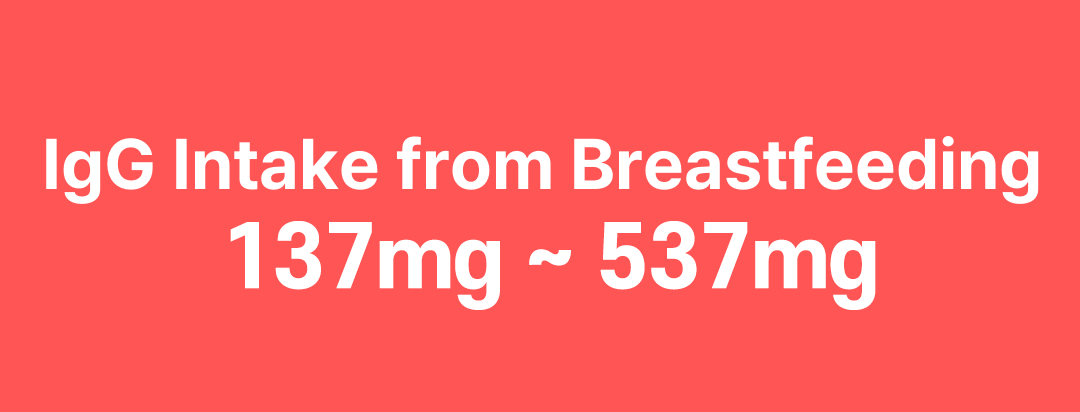
The IgG concentration in breast milk is said to be about 13.7–53.7mg/dl.
If we know how much breast milk a baby drinks, we can figure out the IgG amount.

Assuming a baby drinks 1,000ml of breast milk a day, the total IgG the baby takes in per day is:
13.7–53.7mg/100ml × 1,000ml
= 137–537mg
So the baby gets about 137–537mg of IgG from breast milk.
If you weren’t able to breastfeed your child enough, it’s natural to carry that unease for the rest of your life.
The guilt of feeling like it’s all your fault whenever your child seems even a little weak is probably something many moms feel.
If it really upsets you that your child’s immunity seems weaker than other kids the same age, why not try supplementing at least the amount of IgG they could get from breast milk?
Of course, the IgG intake above is calculated based on what newborns under 6 months take in, so for a child old enough for daycare, a little more should be fine.
By the time my daughter starts daycare at around 3–4 years old, her body weight and blood volume will have roughly doubled since the newborn stage, so I plan to supplement 300mg–1,000mg of IgG — about twice the IgG in breast milk.
5. Colostrum Protein Products: What’s Up with the Colostrum?
If you’re thinking it might be worth supplementing colostrum for your child or your family, now it’s time to go pick a product.
I also searched for “colostrum” and took a close look at products my daughter could take later and products my mom could take now.

The result?
Oh my goodness…
It’s called colostrum protein, but it contained a mere 1–5% colostrum.
They added a measly 1–5% colostrum, and the remaining 90%+ was filled with whey protein or soy protein.
How is this colostrum protein?
I couldn’t help wondering whether it should be renamed “colostrum (trace-added) protein.”
Many YouTubers have also been pointing out problems with the colostrum protein products currently on the market.

The colostrum content in colostrum protein is way too low!
YouTubers are exposing the truth about the colostrum protein on store shelves.
Knowledge really is power — beyond the edited information companies give you, studying things yourself seems to be the way to avoid getting fooled…
I really hate getting ripped off…
I’m the type who researches product specs one by one even when getting my car windows tinted, and studies on my own before signing up for new insurance, so sometimes life feels exhausting.
So let’s go calculate for ourselves how much colostrum is actually in the colostrum products on the market and how much IgG they contain.
6. Colostrum Powder Products on the Market, Analyzed

I chose products mainly by their Amazon search ranking for “colostrum,” picked only one representative product from groups of similar products, and added a few products with distinctive features.
Of course, each product has its own unique features.
Some products add only a small amount of colostrum and focus mainly on plant protein, while others aim to provide well-rounded nutrition.
I’m absolutely not saying any one product is better than another.
So a simple comparison is hard, but since my goal is to get IgG from colostrum for immunity, I looked at products mainly by IgG content and price.
My goal was to find a product with about 300–1,000mg of IgG for my daughter.
1) Brand A

- Total per serving: 30g
- Colostrum per serving: 286.5mg (0.955%)
- IgG content: not disclosed
- $56.79 for a 20-day supply
Brand A is a well-known company that sells mainly through TV shopping channels, with an A-list actor as its exclusive spokesperson.
It records high sales, but its colostrum content is on the very low side, and since it doesn’t disclose its IgG content, there’s no way to know.
The price, at $2.84 a day, is also on the very high side.
With an embarrassing colostrum content of under 1%, it’s hard to call it colostrum protein, so it’s better suited for people who mainly want a regular protein supplement.
I’m not sure exactly how much is in it, but since it has a good mix of vitamins and minerals and even includes digestive enzymes, it seems better suited as an all-around nutrition source for elderly parents than for kids.
2) Brand B

- Total per serving: 34g (one tub: 240g)
- Colostrum per serving: 850mg (2.5%)
- IgG content: 198mg (850mg × 23.3%)
- $17.86 for a 7-day supply
Most colostrum protein products are similar to the one above.
They come in a tub, and the products you scoop out by the heaping spoonful make up a well-known category with strong sales.
From that group, I chose the representative best-seller.
Its colostrum content is 2.5%, more than Brand A, but shouldn’t this one, too, just be called protein rather than colostrum protein…
Like Brand A, it would work best as an all-around nutrition source for older adults.
Because the serving size is large, the amount of colostrum and IgG isn’t bad, but you need to look closely at the price.
$17.86 a tub might not seem that expensive, but since each serving is a whopping 34g, one tub (240g) lasts only about 7 days.
Paying $2.50 a day for 2.5% colostrum plus other proteins is something you should weigh carefully before deciding to buy.
3) Brand C

- Total per serving: 15g
- Colostrum per serving: 1,000mg (6.67%)
- IgG content: 200mg (1,000mg × 20%)
- $19.29 for a 10-day supply
This product is from a company that markets colostrum protein for kids.
The serving size and price aren’t bad, but for me — looking for about twice the IgG in breast milk (300–1,000mg) — 200mg of IgG fell a little short.
One tub is a 10-day supply, so $1.93 a day feels a bit pricey, too.
It contains protein, vitamins, vegetables, and more, so it seems worth considering for kids who barely eat and don’t get enough protein.
Right now I’m judging by the amount of “IgG in the colostrum,” so let’s look at the rest of the products.
4) Brand D

- Total per serving: 3g
- Colostrum per serving: 1,200mg (40%)
- IgG content: 240mg–300mg (1,200mg × 20–25%)
- $46.43 for a 2-month supply
As far as I know, this company was selling colostrum supplements even before colostrum protein became popular.
Its colostrum content is high at 40%, and the price isn’t bad either.
Its IgG content is higher than the products above.
However, it’s a chewable tablet, and the remaining 60% of the ingredients are all sweeteners like glucose, with chemical excipients added, so parents who are sensitive to these things may want to skip it.
(Of course, chemical excipients aren’t bad at all. It’s just that some companies use fear marketing as if they were poison…)
5) Brand E

- Total per serving: 2g
- Colostrum per serving: 2,000mg (100%)
- IgG content: 258mg (2,000mg × 12.92%)
- $11.36 for a 30-day supply
The product above is a 100% colostrum powder product.
Because it’s 100% colostrum powder, it contains a lot of colostrum — 2,000mg per packet — but it uses a raw material with low IgG content (12.92%), so its IgG content isn’t very high, at 258mg.
If only the IgG content were a little higher… that’s my one regret.
That said, it’s great that the price is so low.
Since it’s a 100% colostrum product and inexpensive, I actually bought it and tried it myself.
But after tasting it, I understood why there are no other 100% colostrum products on the market besides this one…
The powder itself has a bland milk taste that can feel a little fishy if you’re squeamish, and once it’s in your mouth, it sticks like flour and won’t come off easily.
On top of that, it didn’t dissolve well in water either.
I don’t think it’s a good idea to try giving a 100% colostrum powder product to kids.
(Even my mom said she couldn’t take this one.)
6) Brand F

- Total per serving: 3g
- Colostrum per serving: 2,000mg (67%)
- IgG content: 664mg (2,000mg × 33.2%)
- $44.15 for a 30-day supply
This is a powder product with 2,000mg of colostrum.
Its colostrum content is the same as Brand E right above, but because it uses a raw material with more than twice the IgG, its IgG content was the highest, at 664mg.
Among the products on the market, I couldn’t find any colostrum other than this one with 33.2% IgG.
I had been looking all along for colostrum products with between 300 and 1,000mg of IgG, and it was the only product that met my criteria.
Also, cows raised in contaminated areas carry a risk of pesticide residues showing up in their milk or colostrum, but this product lists test data showing no pesticides detected, which made me trust it more.
It also has a yogurt flavor that kids will love, so I plan to give this product to my daughter later as she grows.
My mom wouldn’t even touch the 100% colostrum product, but she says this one tastes pretty good.
However, it may not be a good fit for older adults who want extra protein on top of colostrum.
7. Summary

1) Colostrum is rich in immune components, growth factors, and nutrients.
For kids who weren’t able to get enough breast milk, colostrum seems like a good option.
2) The key component of colostrum is the immune component IgG.
3) Kids and adults can take it.
But avoid it for newborns under 6 months.
4) Many colostrum protein products on the market have very low colostrum content, so be careful — check the colostrum content, then calculate how much of it is IgG.
5) I recommend supplementing at least as much IgG as is in breast milk.
6) Comparing products by IgG content, I decided on Brand F, with “colostrum IgG 660mg (33% or more),” for my daughter.
A lot of you have asked for the product name: you can quickly find the Brand F product I chose just by searching “premium colostrum 2000”
Reference
*This content has not been evaluated by the U.S. Food and Drug Administration (FDA). This product is not intended to diagnose, treat, cure, or prevent any disease.