I break down what’s inside our medicines, and especially the supplements that are so hard to understand, in a way that’s easy to follow.
Today, too, I’ll share useful information as simply and accurately as I can, so it can help you make healthy choices.

I see more people than you’d think come in with two particular symptoms.
They are eye twitching and leg cramps.
Both symptoms often stop on their own after a while, and they’re so common in daily life that many people brush them off.
But if these symptoms happen often or last a long time, they may be a signal from your body that goes beyond simple fatigue or stress.
One of the root causes is a lack of magnesium.

But many people who buy magnesium for these symptoms give up halfway because of side effects like diarrhea.
The truth is, magnesium’s absorption rate and side effects are completely different depending on the ingredient.
Which magnesium you choose is what decides whether it works.
Today, I’ll walk you through why you need magnesium for eye twitching and leg cramps, and how to choose the right magnesium.
Table of Contents
1. Why You Need Magnesium for Eye Twitching
2. Are Side Effects Common with Magnesium Supplements?
3. How to Choose the Right Magnesium for You
4. Magnesium Supplement Picks for Every Situation ★
If you want to learn about magnesium, take your time reading, and if you only want the product picks, skip to the bottom.
1. Why You Need Magnesium for Eye Twitching

There are many reasons eye twitching happens, but a common one is that calcium isn’t properly delivered to the eye muscles.
You might be thinking, “Wait, calcium? I thought we were talking about magnesium.”
To be exact, eyelid twitching happens when there isn’t enough magnesium during the process of delivering calcium to the muscles.

Calcium is normally stored in the bones, so it’s rare to run short of it.
But when magnesium levels in the body drop, the release of parathyroid hormone decreases, less calcium moves through the blood, and as a result, less calcium reaches the muscles.
As a result, the muscles react easily even to weak stimulation, causing fine twitching.

So why does twitching start in the eyes first?
Because the eyelid, which blinks more than 10,000 times a day, is the most active muscle in the body.
Since it’s the most active muscle, the eyelid is also the first place to show a signal when magnesium runs low.
You can think of eye twitching as the first warning sign your body sends.
So what kind of nutrient is magnesium, which plays such an important role?

Magnesium (Mg) is the fourth most abundant mineral in the body, found in the bones, muscles, body fluids, and cells.
Put simply, it’s a nutrient involved in energy production and protein metabolism, and it helps with almost every activity in the body, including bone health, nerve and muscle function, and sleep quality.

The problem is that the body can’t make magnesium on its own.
It’s a nutrient you need to get steadily through food, but 53.3% of Americans don’t get enough magnesium from food.
In other words, about half of the population isn’t getting enough magnesium.
Why Do We Run Low on Magnesium?
Because modern daily life itself quickly drains magnesium.
Coffee and alcohol flush magnesium out in urine through their diuretic effect, we eat more processed foods that are low in magnesium, and chronic stress uses up magnesium faster to calm the nerves.
In the end, we’ve ended up in an environment where it’s hard to get enough from meals alone.
2. Are Side Effects Common with Magnesium Supplements?

The side effects people complain about most after taking magnesium supplements are loose stools and diarrhea.
The cause is simple.
It’s because the magnesium we take isn’t properly absorbed in the intestines.

Magnesium isn’t a nutrient that’s absorbed very well to begin with.
Only about 1/10 is absorbed, and the rest passes right out.
This unabsorbed magnesium stays in the intestines and pulls in water, increasing the amount of water in the gut, and as a result, the unabsorbed magnesium makes stools loose and diarrhea more likely.
Because diarrhea is a common side effect of magnesium, many people are reluctant to take it.

In fact, this property of magnesium (its osmotic effect) is also used in constipation treatments.
The main ingredient of Phillips’ Milk of Magnesia, a laxative you can buy over the counter, is magnesium hydroxide, a magnesium that’s barely absorbed, and it works by raising osmotic pressure in the intestines to loosen stools.
Keep in mind that Phillips’ Milk of Magnesia is for treating constipation, not for supplementing magnesium.

Also, taking too much magnesium is a problem too.
If you take more than the recommended amount of magnesium for a long time, your blood magnesium level can climb abnormally high, causing hypermagnesemia.
In severe cases, it can lead to symptoms like trouble breathing, cardiac arrest, and low blood pressure.
We already get a certain amount of magnesium from our daily meals.
If you add a supplement that fills the entire upper limit on top of that every day, the risk of getting too much goes up that much more.
So when choosing a magnesium supplement, rather than chasing the highest dose, it’s important to choose an amount that safely fills only what you’re missing.
3. How to Choose the Right Magnesium for You
As I mentioned earlier, a higher dose doesn’t make a magnesium product better.
On top of that, absorption, stomach irritation, and how you feel all differ depending on the type of ingredient.
So when choosing magnesium, knowing which form of magnesium suits you is far more important than simply looking for the product with the most magnesium.
How to Choose, Tip 1) Magnesium Amount

For adults, the upper limit for magnesium from supplements is 350 mg a day, and since magnesium can be included in many kinds of supplements, you must check that you aren’t doubling up.[1]
Many magnesium products on the market are filled right up to the 350 mg upper limit, and when you add a supplement to the magnesium you get from food, you can go well over the recommended daily intake.
Taking too much magnesium can cause side effects like diarrhea or hypermagnesemia,
and side effects have actually been reported in several studies (Ricci et al., 1991; Bashir et al., 1993)[2][3], so if you’re taking magnesium for general health, about 150 to 200 mg is enough.
(1) Severe magnesium deficiency
→ 250 to 350 mg recommended
(2) General health (maintenance)
→ 150 to 200 mg is right ★
How to Choose, Tip 2) Magnesium Ingredient ★
Let’s look at the magnesium ingredient, one of the most important factors when choosing magnesium.
Just as the metal used decides the quality of jewelry, the same goes for magnesium.
There are many magnesium ingredients on the market, but explaining all of them would make this post too long, so I’ll explain only a few distinctive ingredients.

Ingredient 1) Inorganic Magnesium
Magnesium Oxide, Magnesium Chloride etc.

(1) Inorganic Magnesium: Pros
Most magnesium sold at drugstores is magnesium oxide, a type of inorganic magnesium.
More than 90% of magnesium products on the market use this ingredient.
Because magnesium oxide is an inexpensive ingredient, it’s sometimes rated as low-grade magnesium, but as a commonly used ingredient, it has its advantages too.

The biggest advantage of magnesium oxide is that even if you take a tablet of the same weight, you get more magnesium than with other forms.
If most organic magnesium forms contain 6 to 30% magnesium, magnesium oxide contains as much as 60% magnesium by the same weight.
For example, if you swallow a 500 mg tablet, you get only about 30 mg of magnesium from an organic salt, but about 300 mg from magnesium oxide.
Even if the absorption rate is low, sheer volume wins, so pushing a large amount in means more gets absorbed.
(2) Inorganic Magnesium: Cons
Magnesium oxide is an insoluble magnesium, so it doesn’t dissolve well in water and needs enough stomach acid to dissolve.
Because of this, its absorption rate drops, it stays in the intestines longer, and the magnesium concentration in the intestines rises.
As a result, osmotic pressure in the intestines goes up, more water is drawn in, and too much water builds up in the gut, which can cause side effects like diarrhea.
In fact, quite a lot of people experience diarrhea after taking it.
Also, most magnesium oxide products are high in magnesium, so a single tablet often reaches the daily upper limit.
Especially if you already get enough magnesium from regular meals or take a multivitamin that includes magnesium, I don’t recommend high-dose magnesium oxide.
Ingredient 2) Organic Magnesium
Magnesium Gluconate, Magnesium Glycinate etc.

(1) Organic Magnesium: Pros
Organic magnesium forms, where an organic base like an amino acid is bound to magnesium, use peptide channels in the intestines, so they have the advantage of better absorption.
Unlike magnesium oxide, organic magnesium and chelated magnesium dissolve well in water.
Thanks to this, magnesium is absorbed smoothly even when stomach acid is low.
And because it’s absorbed well even at the same amount, diarrhea side effects are milder too.
(2) Organic Magnesium: Cons
Organic magnesium is made by binding a bulky amino acid to a magnesium atom, so the amount of magnesium that fits in one tablet is relatively low.
As I explained in the magnesium oxide section, organic magnesium contains only 6 to 30% magnesium.
Even if you take a 500 mg tablet, you actually get only about 30 mg of magnesium.
So no matter how well it’s absorbed, the amount of magnesium itself is small, so how much you can take in is bound to be limited.

Organic magnesium products tend to have bulky tablets, so they can be hard to swallow.
The recommended daily serving often means taking 1 to 4 tablets about the size of a quarter, and you have to take that much just to get about the same amount of magnesium as one magnesium oxide tablet.
On top of that, organic magnesium tends to be relatively expensive.
Considering cost versus benefit, I usually don’t go out of my way to recommend it.
Ingredient 3) Naturally Derived Magnesium ★ (Rice Magnesium)

(1) Naturally Derived Magnesium: Pros
The best-known naturally derived magnesium ingredient is rice magnesium, extracted from rice (brown rice).
Unlike synthetic nutrients, your cells don’t recognize it as a foreign substance, so it’s easy on the body, and it’s absorbed well even without an added organic salt.
Because of this, even at the same amount of magnesium, it’s absorbed as well as organic magnesium.
I think it’s the most suitable magnesium ingredient for Americans.

In the same way, because it’s absorbed so well, almost no magnesium is left in the intestines, so diarrhea happens less often.
If your gut is fairly healthy or you don’t have constipation, magnesium extracted from brown rice can be a good option.
There are many reviews saying that even people who avoid magnesium because magnesium oxide gives them diarrhea can take naturally derived rice magnesium steadily without side effects.

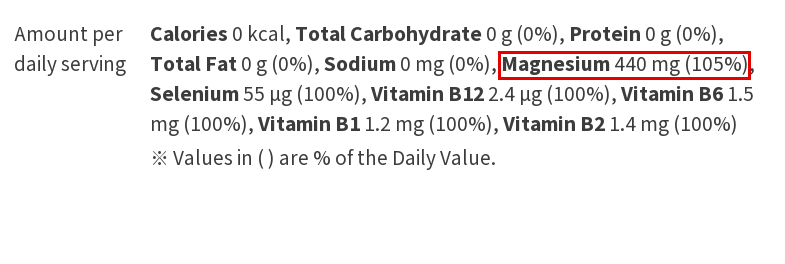
When I looked at rice magnesium products on the market, the magnesium content ranged from 100 to 160 mg.
About 150 mg of magnesium a day is an amount with little risk of overdoing it, and little risk of causing hypermagnesemia.
If your goal for magnesium is general health, I recommend about 150 mg of magnesium.

Also, the number of people eating plant-based is growing these days, and because organic magnesium mainly uses amino acids extracted from animals, it’s hard for vegetarians to take.
On the other hand, rice magnesium is a naturally derived magnesium extracted from plants like brown rice, so vegetarians can take it too, which gives you more options.
(2) Naturally Derived Magnesium: Cons
Because it’s a naturally derived ingredient that hasn’t been around long, its price is relatively high compared with magnesium oxide or organic magnesium.
If a supplement you take for your health gets in the way of daily life because of side effects, you might be better off not taking it at all.
That’s why I personally prefer rice magnesium, a naturally derived ingredient with fewer side effects.
4. Magnesium Supplement Picks for Every Situation
Magnesium Oxide Pick) Nature Made Magnesium 250 mg

* Why I recommend it
- 250 mg of magnesium per daily serving
- USP Verified for quality
- Price: about $6 to $12 (100 to 200 tablets)
- Where to buy: online and in stores
* This information is provided to help you understand the products.
Liquid Magnesium Pick) Floradix Magnesium Liquid Mineral Formula

* Why I recommend it
- Liquid form with 250 mg of magnesium per serving, under the 350 mg supplemental upper limit
- Recommended if you have trouble swallowing tablets
- Price: about $28 for an 8.5 fl oz bottle (about 13 servings)
- Where to buy: online and in stores
* This information is provided to help you understand the products.
Pharmacist’s Pick: Vegan Rice Magnesium Pick) YoungLong Vegan Rice Magnesium

* Why I recommend it
- Naturally derived vegan rice magnesium ingredient
→ almost no feedback about side effects like diarrhea - Relatively high amount among rice magnesium products (160 mg)
- A naturally derived ingredient with good bioavailability (absorption)
- Uses brown rice magnesium, a grade above regular rice
- Small tablets that are easy for anyone to take
- A safe product tested for pesticides and heavy metals
- A vegan certified rice magnesium product
- Price: $31.97 for a one-month supply
- Where to buy: online
* This information is provided to help you understand the products.
Today, we took a look at magnesium.
Magnesium is a mineral modern people really need, but depending on which magnesium you choose, the effects and side effects are completely different.
I want to stress once again that rather than blindly picking a product just because it’s high-dose, the most important thing is choosing an ingredient that fits your condition and goals.
I hope today’s post helps you choose the magnesium product that’s right for you.
* This post reflects Pharmacist Mom’s personal opinion.
Please note that causes of eye twitching and other symptoms can differ depending on each person’s condition.
References
*This content has not been evaluated by the U.S. Food and Drug Administration (FDA). This product is not intended to diagnose, treat, cure, or prevent any disease.